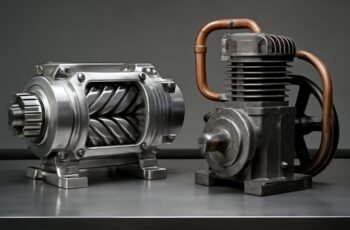
When weighing the merits of stationary versus portable air compressors, the choice often hinges on more than just size or mobility; it’s a matter of aligning specific operational demands with design capabilities. Each type offers distinct advantages and limitations that directly impact cost, efficiency, and suitability for various tasks. Understanding these differences is essential for making an informed decision, especially when project requirements and workspace constraints come into play. Let’s explore how these models compare across key factors to guide your selection.
Key Takeaways
- Stationary compressors are larger, more durable, and suitable for continuous, heavy-duty industrial applications, while portable units are lightweight and ideal for short-term, mobile tasks.
- Stationary models deliver higher horsepower and airflow, whereas portable compressors prioritize quiet operation and easy transportation.
- Stationary units require more space, higher initial investment, and involve regular maintenance; portable units are more compact, cost-effective, and easier to maintain.
- Portable compressors are optimal for infrequent use and quick setup, while stationary compressors are better for high-frequency, long-duration operations.
- Noise levels are generally higher in stationary units, making portable compressors preferable in noise-sensitive environments.
How Do Stationary and Portable Air Compressors Differ in Design and Functionality
Although both stationary and portable air compressors serve the essential function of delivering compressed air, their designs and operational features differ substantially. Stationary units typically feature larger, more robust frames with integrated components optimized for continuous operation, emphasizing durability and stability. In contrast, portable compressors prioritize compactness, lightweight construction, and ease of transport, often incorporating handles and wheels. Design differences also influence noise considerations; stationary models tend to produce higher noise levels due to larger motors and unshielded components, whereas portable units often include noise-reducing features like sound enclosures to minimize sound output. These distinctions directly impact usability, maintenance, and placement, making the choice dependent on application requirements and environment constraints.
Which Air Compressor Is Better for Commercial vs. DIY Use?
When selecting an air compressor for commercial or DIY use, evaluating power output and portability is essential to match operational demands. We also consider how frequently and how long the compressor will be in use, as this influences durability and efficiency requirements. Understanding these factors helps determine whether a stationary or portable model best suits specific workload conditions.
Power and Portability
Have you ever wondered which type of air compressor suits different operational demands better—stationary or portable? When comparing power and portability, stationary units typically deliver higher horsepower and greater airflow, ideal for continuous, heavy-duty tasks. Conversely, portable compressors excel in mobility, featuring compact storage options that facilitate easy transportation. These units often prioritize quiet operation, making them suitable for environments where noise reduction is essential.
- Higher power output for sustained commercial use
- Compact storage enhances ease of transport
- Lightweight design improves mobility
- Quiet operation minimizes disruption in sensitive settings
- Robust construction ensures durability under demanding conditions
Ultimately, the choice hinges on balancing power requirements with the need for ease of movement, with stationary compressors favoring power and durability, and portable units emphasizing convenience and quiet operation.
Usage Frequency and Duration
The frequency and duration of air compressor use considerably influence the most suitable type for a given application. High usage frequency and extended duration of use typically favor stationary compressors due to their durability and capacity for continuous operation. These compressors are designed to handle prolonged workloads without overheating or performance degradation, making them ideal for commercial settings. Conversely, portable compressors are better suited for infrequent or short-duration tasks, such as DIY projects, where mobility and ease of setup outweigh continuous operation capabilities. The choice hinges on how often and how long the compressor will be used; frequent, long-duration use necessitates a stationary model, while sporadic, brief tasks align with portable units. Assessing usage patterns ensures optimal performance and longevity.
What Are the Cost and Maintenance Differences Between Stationary and Portable Models?
Evaluating the cost and maintenance aspects of stationary versus portable air compressors reveals significant differences driven by their design and intended use. A thorough cost comparison shows that stationary models usually involve higher initial investment due to larger components and installation needs. Maintenance requirements tend to be more extensive for stationary units, including routine inspections of belts, motors, and valves, which can incur higher labor costs. Portable models, in contrast, generally require less frequent maintenance, thanks to their smaller size and simpler design. They are more cost-effective upfront and easier to service, but may have higher operational costs over time if used heavily. Key distinctions include:
- Higher initial purchase price for stationary units
- Increased installation costs
- Regular comprehensive maintenance for stationary models
- Simpler maintenance for portable units
- Potential higher operational costs for frequent portable use
How to Choose the Right Air Compressor Based on Your Needs and Space Constraints
When selecting an air compressor, understanding your specific operational needs and spatial limitations is critical to making an informed choice. To optimize performance and budget, evaluate factors like capacity, power, and noise considerations. Larger, stationary units often provide higher CFM and durability but require more space and have a higher cost comparison. Portable models excel in mobility and lower upfront costs but may lack sustained power for continuous tasks.
| Feature | Stationary Compressors | Portable Compressors |
|---|---|---|
| Space Requirements | High | Low |
| Noise Level | Higher | Lower |
| Cost Comparison | Higher | Lower |
| Use Case | Industrial, continuous | Light-duty, mobile |
This table helps clarify your choices based on needs and space constraints.
What Are the Pros and Cons of Stationary Air Compressors?
Stationary air compressors offer significant advantages for industrial and continuous operation environments, but they also come with certain drawbacks. Their stationary pros include high capacity, durability, and energy efficiency, making them ideal for long-term use. However, the portable cons are notable: limited mobility, higher initial cost, and space requirements. These compressors are often more robust and capable of handling demanding workloads, but their fixed installation reduces flexibility. Additionally, maintenance can be more complex due to their size and complexity. For operations requiring consistent, heavy-duty air supply, stationary units excel, but for projects needing portability or quick setup, their limitations become apparent. Understanding these trade-offs helps in choosing the right compressor for specific needs.
What Are the Advantages and Limitations of Portable Air Compressors?
What are the key advantages and limitations of portable air compressors? Their primary advantage lies in their mobility, allowing users to access compressed air in various locations without fixed infrastructure. Additionally, many models are oil free, reducing maintenance complexity and preventing oil contamination of tools or work environments. However, portable compressors often generate higher portable noise levels, which can be disruptive in quiet work settings. Limited tank capacity and lower power output restrict their use to smaller tasks or shorter durations, unlike stationary units. Furthermore, their compact design may compromise durability under heavy-duty applications. While oil-free models improve ease of use, they may have shorter lifespans compared to oil-lubricated counterparts. Overall, portable compressors excel in convenience but face limitations in power, noise, and longevity.
Frequently Asked Questions
How Long Do Stationary and Portable Air Compressors Typically Last?
Stationary air compressors typically last 10-15 years with proper maintenance, thanks to their robust build, while portable units often endure 3-7 years, reflecting their lighter construction and higher wear susceptibility, impacting durability and lifespan.
Are There Safety Concerns Unique to Stationary or Portable Models?
We recognize danger concerns like electrical hazards in stationary models and mobility risks in portable units. Regular maintenance tips, such as checking connections and ventilation, mitigate these risks, ensuring safe operation across both compressor types.
Can Portable Air Compressors Handle Heavy-Duty Industrial Tasks?
Portable air compressors can indeed handle heavy-duty industrial tasks, but their heavy-duty durability often comes with higher maintenance costs. They’re like agile warriors—powerful yet requiring regular upkeep to maintain peak performance in demanding environments.
Do Stationary Compressors Consume More Energy Than Portable Ones?
Stationary compressors typically consume more energy due to their larger capacity and continuous operation needs, but they are more energy-efficient per task. Regular maintenance tips, like checking for leaks and cleaning filters, optimize energy efficiency in both types.
How Easy Is It to Upgrade or Modify Each Type of Compressor?
We find stationary compressors generally easier to upgrade due to their higher upgrading compatibility and modification potential, while portable units present more challenges because of their compact design and limited space for modifications, making upgrades more complex and less flexible.
Conclusion
Ultimately, choosing between stationary and portable air compressors isn’t just a decision—it’s a game-changer. The right compressor can transform your work efficiency, save you from endless downtime, and elevate your projects to new heights of productivity. Make the wrong choice, and you risk costly delays, frustration, and compromised results. We urge you to analyze your needs meticulously—because selecting the perfect compressor isn’t just important; it’s the difference between ordinary and extraordinary success.