Have we ever wished our air compressor could be lighter, quieter, and easier to live with, without giving up real-world performance?

Why We Chose the Senco PC1010N
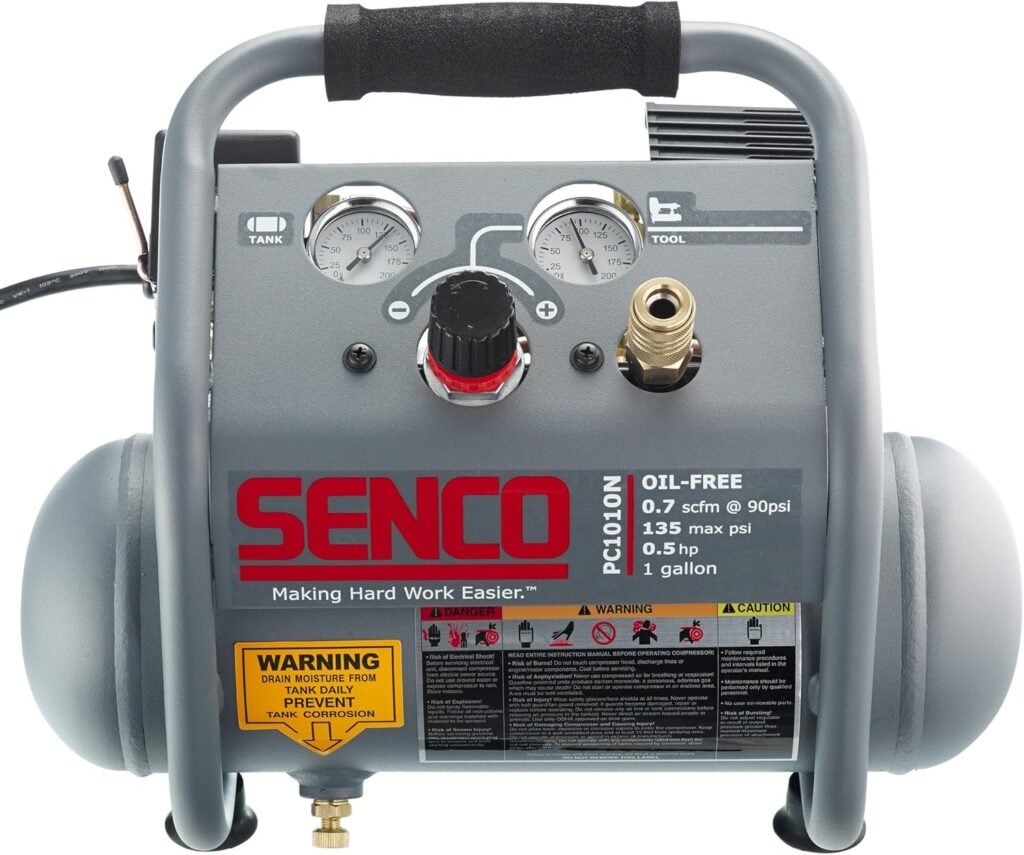
We were looking for a compact, reliable compressor that would actually fit the way we work: small finish jobs, trim installation, and hobby projects where dragging around a huge, roaring compressor just doesn’t make sense. The Senco PC1010N 1/2 hp Finish and Trim Portable Hot Dog Compressor, 1 Gallon, Grey immediately caught our attention because it promised fast recovery, low noise, and a genuinely portable design.
Instead of industrial-sized power, this model focuses on smarter power—enough pressure and capacity for nailers and light tools, in a package that we can carry with one hand and toss in a back seat.
Key Specifications at a Glance
We found it helpful to break down the core specs and features before actually using it. This way, we could see on paper whether it aligned with our typical projects.
| Feature | Specification / Description |
|---|---|
| Model | Senco PC1010N |
| Motor Power | 1/2 HP |
| Tank Capacity | 1 gallon |
| Maximum Pressure | 135 PSI |
| Pump-Up Time (Empty to Full) | Less than 2 minutes |
| Recovery Time (From Use) | Less than 30 seconds |
| Pump Type | Oil-free |
| Design Style | “Hot dog” horizontal tank |
| Dimensions | Approx. 14″ x 13″ x 10″ |
| Portability | Hand-carry design, compact footprint |
| Typical Use | Finish & trim work, hobbies, crafts, light-duty tasks |
| Maintenance | Virtually maintenance-free (no oil changes) |
| Color | Grey |
On paper, the Senco PC1010N reads like a purpose-built, finish-focused compressor, rather than a general all-purpose beast. That became even clearer once we started working with it.
First Impressions and Build Quality
Our first reaction when we picked it up was how manageable the size and weight felt. The 14″x13″x10″ footprint is genuinely compact, and the shape makes it easy to grab and move around without awkward fumbling. It looks and feels like a tool we could actually keep in a closet or trunk, instead of needing a dedicated corner of the garage.
The materials feel solid enough for regular jobsite work, though we would not treat it like an indestructible contractor-grade tank either. The carrying handle is comfortable, the fittings feel snug, and the layout of gauges and controls is straightforward. Nothing about the build suggests it is a toy; it just has a smaller, more refined presence than large wheeled compressors.

Power and Performance in Real Use
The specification that stands out most is the 135 PSI maximum pressure on a 1-gallon tank. On its own, that does not sound like much compared to big shop units, but the real question for us was: does it keep up with typical finish work?
Once we started using it with brad nailers and finish nailers, we found that the answer is yes, as long as we match our expectations to its role. It compresses fast, fills from empty to full in under 2 minutes, and recovers from use in less than 30 seconds. For trim boards, baseboard, crown molding, and light carpentry, we rarely felt like we were waiting around for air.
Where it naturally starts showing its limits is with continuous high-demand tools like framing nailers, roofing nailers, or air-hungry pneumatic equipment. That is not what this unit is designed for. For finish and trim work—its intended purpose—it offers a satisfying blend of speed and convenience.
How It Handles Finish and Trim Work
We noticed that for tasks involving brad nailers (18-gauge) and small finish nailers (15–16 gauge), the compressor cycles on and off in a predictable and non-intrusive way. We could place a series of nails, pause as we position the next piece, and the compressor would top up in the background.
For door casings, interior trim, and small built-ins, we felt it was perfectly matched. We did not experience lag or extended wait times, unless we specifically tried to push it into heavier, continuous use. It is ideal for the kind of work where we move from piece to piece, not for rapid-fire production shots.
Performance for Hobbies and Crafts
We also tried it in a craft-oriented setting: small-scale woodworking, picture frames, light upholstery staples, and similar hobby projects. There, it actually felt like overkill in terms of pressure but just right in terms of responsiveness. The 135 PSI max allows us to dial in the pressure we want while having enough overhead that the compressor is not constantly straining at its limit.
For people who like building DIY furniture, installing custom shelves, or framing art at home, we think it sits in a very comfortable performance zone—enough power to feel professional, yet compact enough to store in a closet.
Noise Level and Everyday Comfort
One of the big selling points is the “quiet motor” claim. While no air compressor is ever truly silent, we found the Senco PC1010N noticeably quieter than larger gas or belt-driven units. This is especially important when we are working in finished or occupied spaces—inside homes, studios, or offices.
Working Indoors Without Disrupting Everyone
We could easily carry on a conversation while it was running nearby. Yes, we still noticed when it kicked on, but it did not dominate the space like a roaring shop compressor. This lower noise level made a real difference in:
- Occupied homes where people are working or relaxing nearby
- Early morning or evening projects when we do not want to be “those noisy contractors”
- Apartment or condo environments where sound carries through walls
We would still prefer hearing protection for longer sessions—after all, it is a motorized machine—but we were not compelled to suit up the moment we turned it on. For us, that says a lot.
Portability and Storage
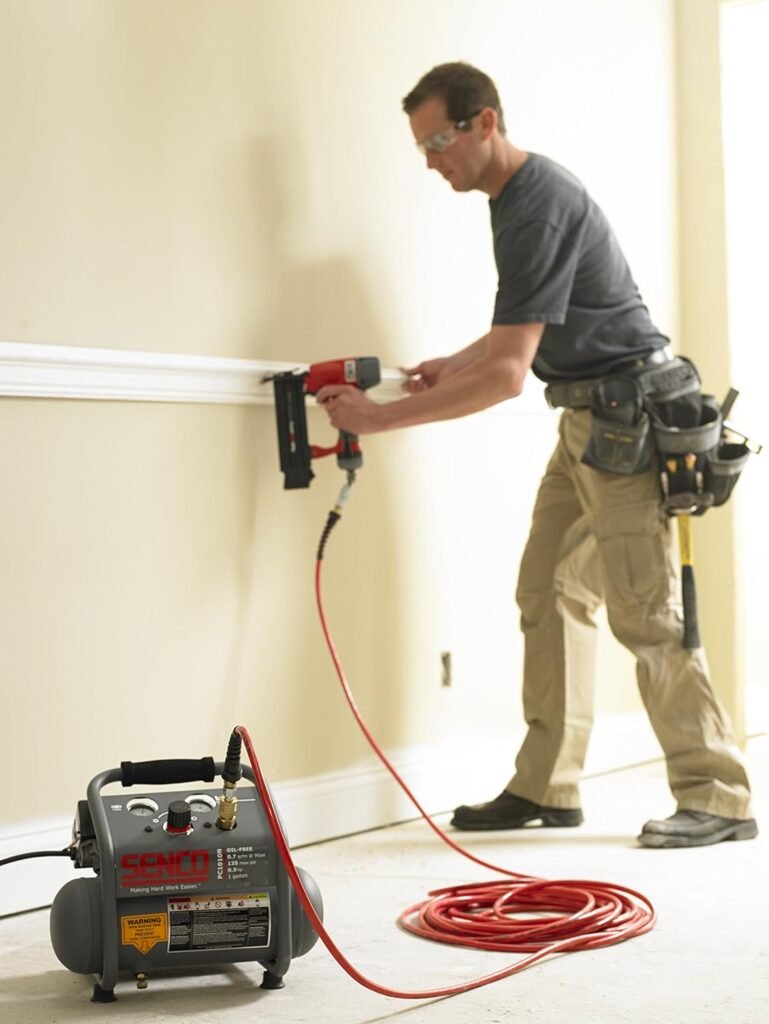
Portability is where this compressor really stands out. The compact design (14″x13″x10″) makes it feel more like a large toolbox than a traditional compressor. We could carry it in one hand while holding a nailer or a box of fasteners in the other.
Easy to Move, Easy to Stow
We found that we could:
- Load it onto a truck bed without needing to rearrange everything
- Set it on a back seat without it tipping over or rolling around
- Store it on a shelf rather than the floor, thanks to its small footprint
For professionals, that means one less bulky piece of gear hogging van or trailer space. For homeowners, it means a tool that does not require reorganizing the entire garage just to keep it around for the next project.
Oil-Free Pump and Maintenance
One of our favorite aspects is the oil-free design. Traditional compressors often need periodic oil changes and can occasionally mist oil into the air stream, which is not ideal for clean indoor work. With the Senco PC1010N, we did not have to worry about oil levels, oil spills, or oil-contaminated lines.
What Oil-Free Means for Our Work
In day-to-day use, an oil-free pump translates into:
- Virtually no pump maintenance
- Cleaner air output, especially useful when we are working in finished interiors
- One less consumable (compressor oil) to buy and keep track of
We still need to perform basic compressor care—like draining condensation from the tank—but that is true of any compressor. Compared with older, belt-driven, oil-lubricated units, the simplicity here feels refreshing.
Controls, Gauges, and Ease of Use
The interface on the Senco PC1010N is straightforward, which is exactly what we want in a small jobsite or home compressor. There are no confusing controls or mysterious switches; everything is laid out logically.
Getting It Up and Running
In everyday use, our typical workflow is:
- Place the compressor on a stable surface.
- Plug it into a standard outlet.
- Turn it on and let it reach full pressure (under 2 minutes).
- Connect our hose and tool, then adjust output pressure as needed.
The gauges are easy to read, and we could quickly see both the tank pressure and regulated output pressure. Adjustments are simple, and the regulator responds predictably.
Strengths of the Senco PC1010N
We appreciate products that clearly know what they are meant for, and this compressor has that focused purpose. Its strengths align perfectly with its target use cases, making it an excellent choice for certain users.
Where It Really Shines
We see the Senco PC1010N excelling in these specific areas:
- Finish and trim carpentry: Installing baseboards, door and window trim, crown, and wainscoting with brad or finish nailers.
- Indoor work: Thanks to its quieter operation and small footprint, it suits occupied homes and renovation work.
- Hobbies and crafts: Woodworking, picture frames, small furniture, and craft projects that use brad nailers or staples.
- Portability-focused tasks: Quick jobs where lugging a large compressor would be overkill.
Every time we needed a compact, easy-to-carry air source that would not overwhelm the room, this compressor felt like the right call.
Limitations and What It Is Not Designed For
To give a fair and complete picture, we also need to highlight where the Senco PC1010N is not the best choice. Understanding its limitations helps us avoid frustration and choose the right tool for the right job.
Not a Heavy-Duty Construction Workhorse
With a 1-gallon tank and 1/2 hp motor, this unit simply is not built for:
- Framing nailers used in rapid succession
- Roofing nailers on shingle-heavy jobs
- Sandblasters or very air-hungry pneumatic tools
- Continuous, multi-user operation on a large jobsite
If we routinely frame houses, install roofing, or run multiple air tools at once, we would outgrow this model quickly. It is better suited as a trim and finishing companion, not a stand-alone solution for all compressed air needs.
Not Ideal for Large-Scale Painting and Spraying
While it can power some small touch-up or detail sprayers that require lower CFM, large-scale painting, automotive spraying, or high-demand HVLP work is outside its comfort zone. The small tank and limited output will lead to frequent cycling and inconsistent performance for such demanding tasks.
Comparing the Senco PC1010N to Larger Compressors
We often think about tools in terms of trade-offs. The Senco PC1010N makes particular trade-offs in favor of convenience and mobility, so it helps to see how it stacks up against more traditional units.
Key Trade-Offs
Compared to larger, wheeled, multi-gallon compressors, we sacrifice:
- Tank capacity (only 1 gallon)
- Continuous airflow capability
- Multi-tool support on large jobs
In return, we gain:
- Extreme portability
- Easier storage
- Lower noise
- Oil-free simplicity
For us, the choice comes down to intended use. For a dedicated finish and trim compressor, the Senco PC1010N makes more sense than hauling around a bulky unit that spends most of its time idling.
Who Will Benefit Most from This Compressor?
Rather than saying this tool is right for “everyone,” we think it is more accurate to pinpoint who will genuinely get the most value out of it.
Ideal Users
We see the Senco PC1010N as a particularly strong option for:
- Trim carpenters and remodelers who need something light and quiet for punch lists, small rooms, and finishing touches.
- DIY homeowners who like doing their own trim, molding, and light carpentry but do not want a massive compressor dominating their garage.
- Hobbyists and craft enthusiasts who use brad nailers, staplers, or light pneumatic tools occasionally and value compactness.
- Property managers or maintenance staff who need a portable compressor for quick repairs and touch-ups across multiple units.
In all these cases, we get a capable, reliable air source without stepping into industrial territory.
Day-to-Day Experience on Real Projects
Numbers and specs tell part of the story, but we found the true character of the Senco PC1010N comes out in everyday use. We carried it to jobs, set it up in living rooms, and used it for quick tasks in garages and workshops.
Small Renovations and Interior Trim
During interior remodels, the compressor was easy to bring inside without worrying about scuffing walls or tracking dirt, thanks to its manageable size. When we were installing baseboards and door casings, it provided consistent pressure for our brad and finish nailers. The quieter motor meant we could keep it relatively close without it being overwhelming.
Over the course of several rooms, the unit cycled predictably. As long as we worked at a normal pace—position piece, shoot a few nails, step back and measure the next run—it did not hold us back.
Quick Repairs and Punch-List Tasks
We also used it for tasks like reattaching loose trim, installing a few pieces of casing around a new window, and fixing squeaky or shifting molding. For that kind of work, the compressor really shines. We could grab it, plug it in, let it build up pressure, and finish a small job before a bulkier compressor would even be fully set up.
In these situations, its compact size and rapid recovery mattered far more than having a large tank.
Longevity and Reliability Considerations
While long-term durability always depends on how we treat a tool and how often we use it, certain design choices here suggest reasonable reliability for its role.
What We Expect Over Time
Because it is oil-free, we do not have to worry about oil contamination or regular oil changes, which are common failure points in some compressors if neglected. The simpler motor and pump design reduce the number of maintenance items. As with any compressor, the main long-term care points are:
- Draining moisture from the tank regularly
- Avoiding continuous overloading beyond its intended usage
- Protecting it from severe impacts, excessive dust, and harsh environments
If we use it primarily for trim and crafts and treat it as a precision tool rather than a rough construction site tank, we expect it to hold up well.
Practical Tips for Getting the Best Results
We want to share a few practical ways we managed this compressor to get the most out of it. These are small habits, but they can make a real difference in daily use.
Matching Tools to the Compressor
We found that pairing it with the right tools kept performance smooth and frustration low. Ideal companions include:
- 18-gauge brad nailers
- 15–16 gauge finish nailers
- Light-duty staplers
- Low-demand touch-up sprayers (where compatible)
Using high-demand tools will not necessarily “break” it, but we will quickly run into limitations in recovery and sustained pressure.
Managing Air Usage During Projects
We learned to work in a rhythm that aligns with the compressor’s strengths:
- Grouping shots when possible
- Allowing short pauses between rapid bursts of nailing
- Letting the compressor fully build to maximum pressure before heavy sequences
These habits prevent unnecessary stalling and make the whole experience smoother.
Pros and Cons Summary
To make everything clearer, it helps to put the major advantages and drawbacks side by side.
| Pros | Cons |
|---|---|
| Compact and lightweight; very easy to carry | Small 1-gallon tank limits continuous use |
| Maximum pressure of 135 PSI for effective finish work | Not ideal for framing, roofing, or high-demand tools |
| Fast pump-up (under 2 minutes) and quick recovery | Single-tool focus; not suited for multi-user jobsite use |
| Oil-free pump; minimal maintenance required | Limited suitability for large-scale spraying or painting |
| Quieter than traditional gas and many belt-driven units | Still produces noise; not “silent” |
| Clean, tidy design suitable for indoor work | Less rugged than heavy-duty industrial compressors |
| Great for hobbies, crafts, and DIY projects | May feel underpowered if we expect it to replace a large unit |
Looking at this table, we see a compressor that is excellent at what it is meant to do and transparently not built for everything under the sun.
How It Fits into a Broader Tool Setup
Instead of thinking of the Senco PC1010N as our only compressor for all future tasks, we found it helpful to see it as a specialized part of a broader toolbox.
A Complement, Not Always a Replacement
For many of us, the most sensible setup looks like this:
- A compact trim compressor like the Senco PC1010N for finish work, indoor tasks, and small projects.
- A larger shop or jobsite compressor for heavy framing, roofing, and high-demand pneumatic tools.
If we rarely do heavy construction, we may choose to own only the compact unit. But even if we have a big compressor, having a smaller, portable one dedicated to finish tasks is surprisingly convenient.
Our Overall Opinion on Value
When we balance everything—performance, convenience, maintenance, and limitations—we think the Senco PC1010N offers very good value for what it is designed to do. It does not try to be a universal solution; it focuses on finish and trim, and it does that job very well.
Where We Feel the Value Most
We especially appreciate its value in these scenarios:
- When we need to enter finished, lived-in spaces with minimal disruption
- When we have frequent small projects that do not justify setting up a large compressor
- When storage space is limited and compactness matters
For professionals, the time saved in setup, transport, and noise management can easily justify keeping a unit like this in the vehicle. For homeowners and hobbyists, it offers a professional-grade feel without the overhead and footprint of a large system.
Final Thoughts: Is the Senco PC1010N Right for Us?
Our conclusion is that the Senco PC1010N 1/2 hp Finish and Trim Portable Hot Dog Compressor, 1 Gallon, Grey is a thoughtfully designed tool that fits perfectly into a very specific niche: finish and trim work, indoor tasks, and light-duty DIY or craft use.
If we want a compressor that is:
- Compact enough for easy storage and transport
- Quiet enough to run indoors without overwhelming the space
- Simple to maintain thanks to its oil-free design
- Strong enough for brad and finish nailers at up to 135 PSI
then this model is a strong contender.
However, if our regular work involves heavy framing, roofing, or multiple pneumatic tools operating simultaneously, we should see it as a supplemental specialty unit rather than our only compressor.
In short, for finish carpentry, trim installation, and small-scale projects where portability and comfort matter, we find the Senco PC1010N to be a smart, user-friendly choice that earns its place in our toolkit.
Disclosure: As an Amazon Associate, I earn from qualifying purchases.