While some might assume that choosing between reciprocating and rotary screw compressors is straightforward, the decision demands a careful analysis of operational needs and long-term costs. Each type offers distinct advantages suited to different applications, yet understanding their technical differences is essential for making an informed investment. As we explore the core mechanisms, performance metrics, and cost implications, you’ll see why selecting the right compressor is more complex than it appears—and why it matters considerably for your operations.
Key Takeaways
- Reciprocating compressors are suitable for intermittent, high-pressure applications, while rotary screw compressors excel in continuous, steady airflow needs.
- Rotary screw units operate more quietly and with higher energy efficiency compared to noisier reciprocating models.
- Reciprocating compressors typically have lower initial costs but higher maintenance and operational expenses over time.
- Rotary screw compressors require less maintenance due to fewer moving parts, offering better durability for continuous use.
- Application environment and noise sensitivity influence the choice, with rotary screw compressors preferred for shared or noise-sensitive spaces.
What Are Reciprocating and Rotary Screw Compressors?
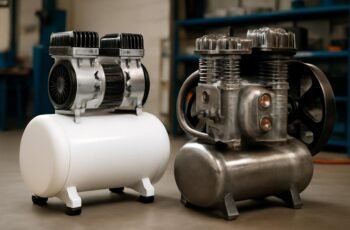
Reciprocating and rotary screw compressors are two primary types of positive displacement air compressors, each employing distinct mechanisms to compress air. Reciprocating compressors operate via pistons moving within cylinders, leading to higher noise levels due to their mechanical vibrations and intermittent operation. They typically have longer startup timings, as the piston assembly needs to reach operational speed before generating full pressure. In contrast, rotary screw compressors utilize a continuous rotary motion of intermeshing screws, resulting in quieter operation and smoother airflow. Their startup timings are shorter because they reach operating conditions more quickly, thanks to their design’s inherent efficiency. Understanding these differences helps in selecting the right compressor based on application requirements, especially concerning noise levels and startup timings.
How Do Reciprocating Compressors Work?
How exactly do reciprocating compressors generate compressed air? They operate through a piston-cylinder mechanism driven by a crankshaft, which converts rotary motion into reciprocating motion. As the piston moves down, it draws in ambient air through an intake valve; moving up, it compresses the air, forcing it out through the discharge valve. This cycle repeats rapidly, producing high-pressure air. The design influences energy efficiency and noise levels, with more efficient models minimizing energy loss and reducing operational noise.
| Component | Function | Impact on Performance |
|---|---|---|
| Piston | Compresses air during upward stroke | Key to compression ratio |
| Cylinder | Houses piston, facilitates smooth movement | Affects energy efficiency |
| Valves | Control air intake and discharge | Influence noise levels |
| Crankshaft | Converts rotary to reciprocating motion | Impacts energy consumption |
How Do Rotary Screw Compressors Operate?
Rotary screw compressors operate through precisely engineered rotor engagement, where intermeshing rotors create sealed chambers that facilitate compression. As the rotors turn, air is drawn in and compressed within these chambers, producing a continuous flow of high-pressure air. Understanding this mechanism allows us to analyze how the compression process maintains efficiency and consistency in rotary screw systems.
Rotor Engagement Mechanism
Ever wondered how rotary screw compressors achieve continuous compression? The key lies in the rotor engagement mechanism, which ensures synchronized operation of the male and female rotors. These rotors are precisely timed through gear engagement or direct drive systems, maintaining constant meshing without interruption. The lubrication strategy plays a critical role here, reducing friction and preventing rotor contact, which preserves efficiency and prolongs component life. Proper lubrication also minimizes wear during rotor engagement, ensuring smooth operation at high speeds. The mechanism relies on high-precision manufacturing and maintenance to sustain tight clearances, preventing air leakage and maintaining compression consistency. This combination of rotor engagement and strategic lubrication enables rotary screw compressors to operate continuously with minimal downtime and optimal performance.
Air Compression Process
Have you ever considered the precise mechanics behind the operation of rotary screw compressors? These devices compress air through meshing helical rotors, which rotate within a casing. As the rotors turn, air is trapped in the cavities between the rotors and the casing, reducing in volume as it progresses toward the discharge port. The use of stainless steel rotors enhances durability and corrosion resistance, ensuring long-term efficiency. Noise reduction is achieved through optimized casing design and the elimination of pulsations common in reciprocating types. Key aspects include:
- Continuous, smooth compression with minimal pulsation
- Precise rotor engagement for consistent airflow
- Noise dampening features integrated into the casing
This process results in quieter operation and reliable, steady air delivery.
Comparing Performance: Power, Efficiency, and Maintenance
How do reciprocating and rotary screw air compressors compare in terms of power, efficiency, and maintenance? Reciprocating compressors generally deliver high reciprocating efficiency at lower capacities, making them suitable for intermittent use. Their power output is variable, but efficiency drops at higher loads due to increased internal friction and reciprocating motion. Rotary screw compressors, on the other hand, maintain consistent rotary torque, enabling smooth operation and better energy efficiency, especially at continuous duty cycles. Maintenance for reciprocating units involves more frequent repairs due to piston wear and valve issues, while rotary screw compressors typically require less maintenance, thanks to fewer moving parts. Overall, rotary compressors excel in operational efficiency and durability, but reciprocating models may be advantageous for short-term, high-pressure applications.
Which Compressor Is Better for Small-Scale Use?
When selecting an air compressor for small-scale applications, the decision hinges on balancing capacity, efficiency, and maintenance requirements. For limited use, reciprocating compressors often excel due to their smaller footprint size and lower initial costs, making them suitable for tight spaces. They generally produce higher noise levels, which may be acceptable in less sensitive environments but could be problematic in noise-restricted settings. Rotary screw compressors, on the other hand, tend to operate more quietly and offer continuous operation, albeit at a higher upfront investment.
Reciprocating compressors are compact and affordable but noisier, while rotary screw units offer quieter, continuous operation with higher upfront costs.
Consider these factors:
- Reciprocating compressors are more compact but noisier.
- Rotary screw units offer quieter operation and steadier airflow.
- Footprint size and noise levels are crucial in small, noise-sensitive environments.
Which Compressor Fits Industrial and Continuous Operations?
When selecting a compressor for industrial and continuous use, durability and reliability are essential to minimize downtime and ensure consistent operation. We also consider maintenance and operating costs, as these impact long-term efficiency and budget planning. Evaluating these points helps determine which compressor type best supports demanding, ongoing workflows.
Durability and Reliability
Determining which compressor best suits industrial and continuous operations hinges on their durability and reliability under demanding conditions. Reciprocating compressors are known for robustness, but their moving parts require regular lubrication, making discussing lubricants essential for longevity. Rotary screw compressors excel in continuous use, offering consistent performance with minimal wear, but addressing noise levels is vital for operation in sensitive environments.
- Reciprocating units tend to have shorter lifespans under constant duty due to piston wear.
- Rotary screws generally provide higher reliability, especially with proper lubrication and cooling.
- Noise levels are typically lower in rotary screw models, favoring quieter operation over reciprocating counterparts.
Both types can be durable, but rotary screws often deliver better reliability for sustained, industrial applications.
Maintenance and Operating Costs
Although both reciprocating and rotary screw compressors require regular maintenance, their operating costs differ significantly in industrial and continuous applications. Reciprocating compressors generally have higher wear resistance in their pistons and valves, leading to increased maintenance intervals but higher repair costs when issues arise. Conversely, rotary screw compressors typically feature superior wear resistance in their rotors, enabling smoother operation and reduced downtime. Operating costs for rotary screw units tend to be lower over time due to less frequent maintenance needs. Noise comparison also favors rotary screw compressors, as they produce less noise and vibration, which minimizes wear on components and further reduces maintenance expenses. For continuous, high-demand environments, rotary screw compressors often present a more cost-effective solution due to their durability and quieter operation.
Cost Differences and Long-Term Investment Considerations
Have you considered how the initial purchase price and ongoing operational costs influence the long-term value of reciprocating versus rotary screw air compressors? Generally, reciprocating models have lower upfront costs but higher maintenance expenses, whereas rotary screw units tend to have higher initial investments aligned with better energy efficiency and lower noise levels. Price trends show that rotary screw compressors are becoming more cost-competitive due to advances in technology. Long-term investments should factor in energy savings, reduced downtime, and durability.
Initial costs matter, but consider energy efficiency and durability for true long-term value of air compressors.
- Reciprocating compressors offer lower initial costs but may incur higher maintenance and energy costs over time
- Rotary screw compressors typically have higher upfront prices but benefit from lower noise levels and energy efficiency
- The overall cost-benefit hinges on operational demands and expected lifespan
Pros and Cons of Reciprocating vs Rotary Screw Compressors
What are the key advantages and disadvantages of reciprocating versus rotary screw compressors? Using a comparison method, we find that reciprocating compressors excel in applications requiring high pressure and low volume, offering simplicity and durability. However, they tend to be noisier, less efficient at continuous operation, and require more maintenance. Rotary screw compressors, on the other hand, provide smoother, quieter operation with higher efficiency and better suitability for continuous use. Their design allows for easier maintenance and lower operational costs over time. The comparison method reveals that reciprocating units are better for intermittent, high-pressure tasks, while rotary screw models are ideal for large-scale, steady airflow needs. Ultimately, the choice hinges on specific application demands, balancing efficiency, maintenance, and operational longevity.
How to Choose the Right Air Compressor for Your Needs
Selecting the right air compressor requires a clear understanding of your specific operational demands, as different applications prioritize varying performance characteristics. Key factors include noise considerations, environmental impact, and energy efficiency. For quieter operation, reciprocating compressors typically generate more noise, which may influence indoor or noise-sensitive environments. Rotary screw compressors tend to operate more quietly, making them suitable for continuous use in shared spaces. Additionally, assessing environmental impact involves evaluating energy consumption and emissions; rotary screw models often have higher efficiency and lower emissions. Consider your airflow requirements, duty cycle, and long-term operational costs. Lastly, evaluate maintenance needs and scalability to ensure the compressor aligns with your future growth plans. Proper analysis ensures optimal performance and sustainability for your specific application.
Frequently Asked Questions
What Are the Typical Applications for Reciprocating Versus Rotary Screw Compressors?
We find reciprocating compressors ideal for high-pressure, low-volume tasks due to their efficiency, while rotary screw compressors suit continuous, high-volume applications thanks to their easier rotary maintenance and consistent performance in industrial settings.
How Do Noise Levels Compare Between the Two Compressor Types?
We find rotary screw compressors generally produce lower noise levels and vibration effects than reciprocating models, making them more suitable for noise-sensitive environments; reciprocating compressors tend to generate higher noise due to piston movement and mechanical vibrations.
What Environmental Factors Influence Compressor Selection?
Like choosing a path through a dense forest, environmental regulations and energy efficiency guide compressor selection. We evaluate factors such as noise, emissions, and power consumption, ensuring compliance and sustainability while optimizing performance in diverse operational environments.
Are There Specific Industries Where One Compressor Type Is Preferred?
We find reciprocating compressors preferred in industries demanding high reciprocating efficiency, like automotive and small-scale manufacturing, while rotary screw compressors excel where minimal rotary maintenance is essential, such as large-scale manufacturing and continuous process industries.
How Does Downtime and Repair Frequency Differ Between the Two?
We find reciprocating compressors have a downtime comparison of about 15-20% higher than rotary screw models, mainly due to increased repair frequency, which is driven by their more complex mechanisms and piston wear over time.
Conclusion
Ultimately, choosing between reciprocating and rotary screw compressors is like selecting the right vessel for a voyage. Each has its purpose—one excels in short, high-pressure tasks, while the other is built for continuous, steady journeys. By analyzing your operational needs, efficiency goals, and budget, we can steer toward the most suitable choice. The right compressor becomes more than equipment; it’s the steady engine propelling your projects forward with precision and reliability.