Have we ever wished our air tools ran smoother, our compressor stayed drier, and our finishes came out cleaner with less hassle?

What Is the ORAZIO Air Filter Regulator 3/8 and Who Is It For?
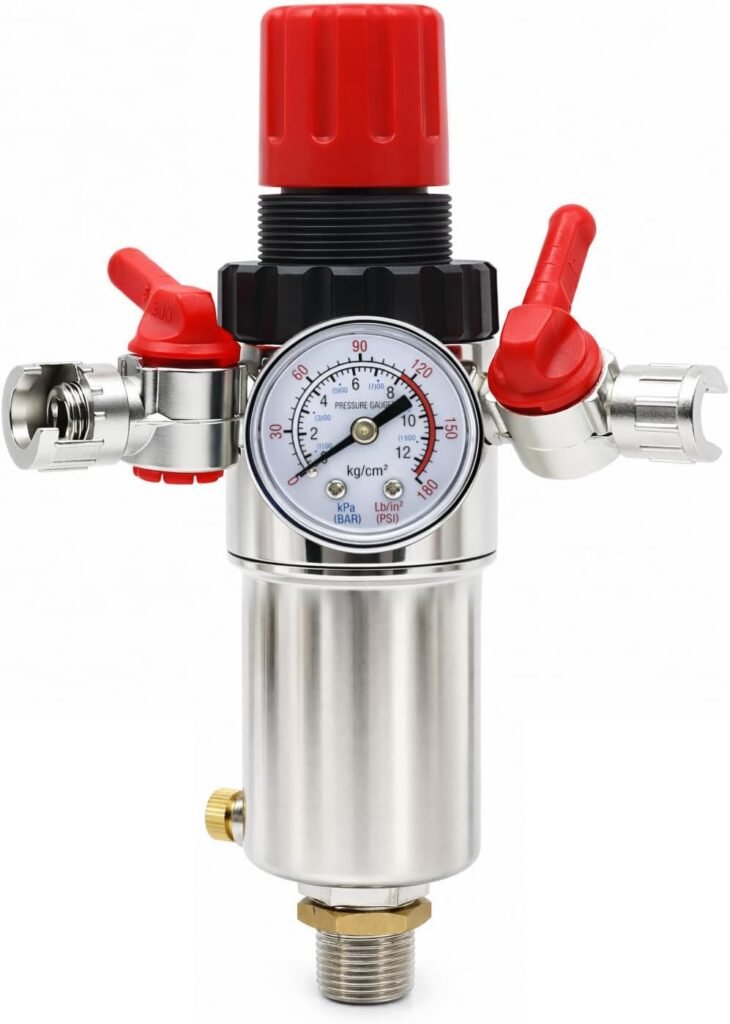
This ORAZIO Air Filter Regulator 3/8″ is a compact, heavy-duty air treatment unit designed to clean, regulate, and manage airflow from our compressor to our pneumatic tools. It combines a moisture water separator, a pressure-reducing valve, and a pressure gauge into one convenient assembly.
We are looking at a product aimed at anyone who uses compressed air regularly—DIY hobbyists, home garages, small workshops, and even light professional environments. If we rely on air tools for painting, inflating, or operating nailers and impact wrenches, this unit can make our setup more reliable and consistent.
Key Features at a Glance
Before we get into how it performs in real use, it helps to see the main specs in one place. This gives us a quick sense of whether it fits our compressor and tools.
| Feature | Specification / Description |
|---|---|
| Product Name | ORAZIO Air Filter Regulator 3/8″ |
| Function | Air filter + moisture separator + pressure regulator + gauge |
| Body Material | Heavy-duty aluminium alloy valve assembly |
| Filter Type | Integral filter with moisture/water separator |
| Pressure Reducing Valve | With gauge (40 mm diameter) |
| Airflow Control | Lockable control knob (prevents accidental adjustment) |
| Mounting Options | Direct compressor mounting or inline in air line |
| Air Outlets | 2 x 1/4″ outlets |
| Bottom Thread | 16 mm |
| Water Bowl Capacity | 15 cm² (small but adequate for typical DIY/light shop use) |
| Max Flow Rate | 2500 L/min |
| Max Operating Pressure | 12 bar |
| Body Size | 13.2 x 6.5 x 17 cm |
We can already see that this is not just a basic regulator; it gives us filtration, moisture removal, and pressure control in a compact, metal-bodied unit.
Build Quality and Construction
Heavy-Duty Aluminium Alloy Body
The first thing that stands out is the heavy-duty aluminium alloy valve assembly. This matters because air systems often live in tough environments—garages, basements, shops—where tools get bumped, dropped, or knocked around.
We appreciate that ORAZIO did not go for a flimsy plastic regulator body. The metal construction inspires more confidence, especially when we are working at pressures up to 12 bar. It feels like a unit we can install and not worry about every time we turn on the compressor.
Sturdy, Compact Design
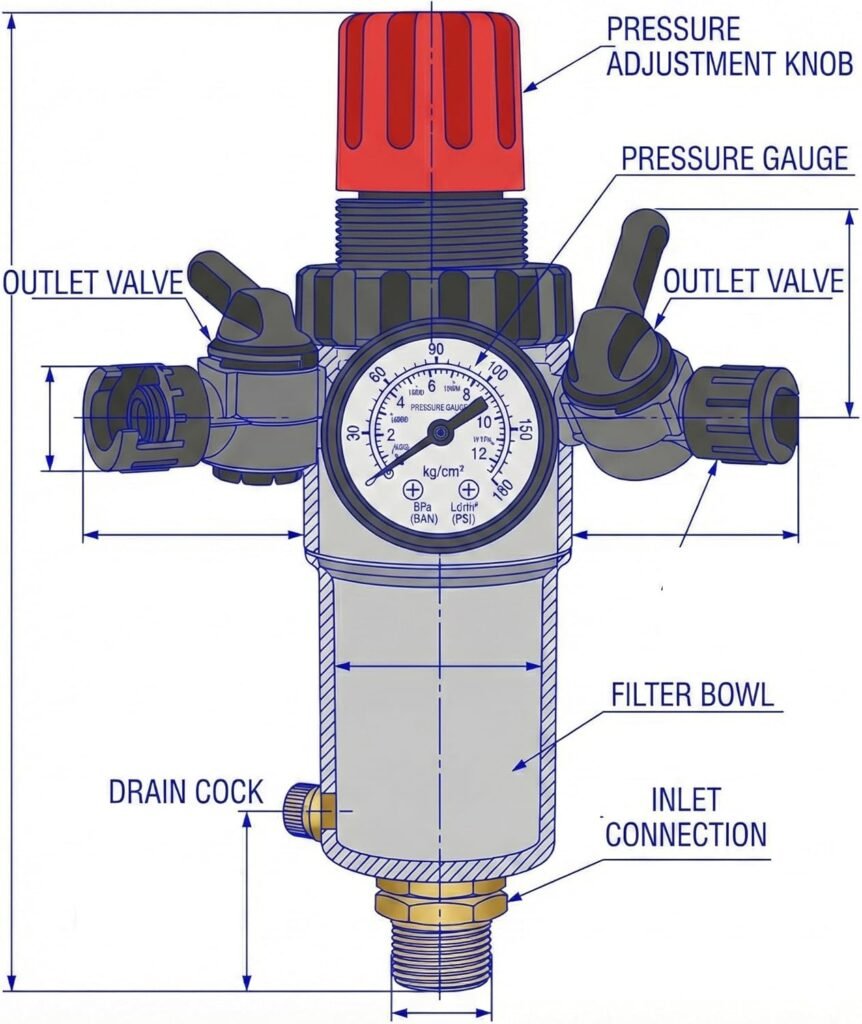
At 13.2 x 6.5 x 17 cm, the regulator is compact enough to mount directly on many compressors without feeling bulky. The layout of the body, bowl, and gauge seems designed for clarity: gauge on the front, bowl below, and controls within easy reach.
We like that the overall design balances ruggedness with practicality. It looks like the sort of accessory we can add to an existing setup without needing to rearrange the entire bench or piping.
Filtering and Moisture Separation Performance
Integral Filter for Cleaner Air
One of the main reasons we reach for a unit like this is to protect our tools and improve our end results. The integral filter is built into the valve assembly, meaning we do not need a separate inline filter. It helps remove particulates from the air stream, such as dust, scale from pipes, and compressor debris.
We might not always notice the filter doing its job day-to-day, but the difference becomes clear over time: cleaner tools, fewer clogs, and smoother operation. Especially for sensitive tools like spray guns or small pneumatic ratchets, cleaner air matters a lot.
Moisture and Water Trap Function
Compressed air naturally collects moisture as it cools, and that moisture travels through our lines unless we remove it. The built-in water separator and bowl help collect condensed water so it does not head straight into our tools or paint.
We like that the water bowl capacity of 15 cm² is clearly stated. While it is not huge, for a typical DIY or light workshop setup, that capacity is usually enough as long as we drain it regularly. This is especially important for painting, where water in the airlines leads to fish-eyes, rough textures, and inconsistent finishes.

Pressure Regulation and Control
Pressure Reducing Valve With 40 mm Gauge
The integrated pressure-reducing valve is one of the core functions of this ORAZIO unit. By stepping down our compressor’s tank pressure to the ideal working pressure, it ensures our tools see stable, controlled airflow.
The 40 mm diameter gauge is easy to read at a glance. We can quickly set our working pressure based on the tool requirements—whether that’s around 2–3 bar for many airbrushes and spray guns, or higher for impact wrenches and inflators. Being able to see the pressure right there on the unit helps avoid guesswork.
Lockable Airflow Control Knob
We especially value the lockable airflow (pressure) control knob. Once we dial in the desired pressure, we can lock the knob in place to prevent accidental bumps from changing our settings.
This is particularly useful if we share a workspace with others or move around a lot in a tight shop. We do not want our finely tuned spray gun pressure to shift just because something brushed against the regulator.
Airflow, Capacity, and Performance
Max Flow Rate of 2500 L/min
With a maximum flow rate of 2500 L/min, this unit is more than capable of handling most home and small workshop air needs. For typical compressors used with nailers, impact wrenches, blow guns, and paint sprayers, that flow rating is comfortably within range.
We find that this kind of headroom is useful when running more air-hungry tools or when we want to avoid pressure drops during continuous use. It gives us a bit of future-proofing if we upgrade to a slightly larger compressor later.
Max Operating Pressure of 12 Bar
The maximum operating pressure of 12 bar (roughly 174 psi) means it is compatible with many standard and slightly higher-pressure systems. Even if our compressor tank goes up near that range, we are still within the safe operating limits of the unit.
We appreciate having a clear maximum rating so we can match it with our compressor specs. This prevents us from pushing the regulator beyond what it was designed to handle.
Connections and Compatibility
3/8″ Main Size With 1/4″ Air Outlets
Although the product is labeled as a 3/8″ air filter regulator, it offers two 1/4″ air outlets. The bottom thread is 16 mm, which we might need to adapt depending on our compressor’s port sizes and our existing hose fittings.
We should expect to use some basic adapters or quick-connect couplers to integrate this neatly. Thankfully, 1/4″ outlets are quite standard in many home and light shop air systems, so connecting common hoses is usually straightforward.
Two Separate 1/4″ Outlets
Having two air outlets is more useful than it might seem at first glance. We can run two hoses from the same regulator, or have one permanent line and one temporary hook-up for tools we use less often.
We could, for example, keep a hose for a tire inflator and another for tools like impact wrenches or blow guns. It saves us from constantly swapping couplers or installing a separate manifold.
Mounting and Installation
Direct Mounting on Compressors
ORAZIO states that this unit is suitable for direct mounting onto compressors. That is handy if our compressor does not already have a decent filter-regulator system built in. The compact size makes it feasible to attach near the outlet, keeping everything close and tidy.
We will want to ensure we mount it in a position where the gauge and knob are easy to see and use, and where we can easily access the water bowl for draining.
In-Line Mounting in Air Lines
Alternatively, we can plumb the unit into our existing airline runs. This is a good choice if our compressor is in a different room or we want cleaned and regulated air at the point of use (for example, right next to our workbench or spray booth).
We like the flexibility of both mounting styles. It allows us to integrate the ORAZIO regulator into older systems or new setups without major reconfiguration.
Using the ORAZIO Regulator in Real-World Tasks
General Workshop and Garage Use
For day-to-day tasks—blowing off dust, inflating tires, running nail guns—the ORAZIO regulator provides a solid layer of control and safety. We can set a comfortable pressure level for each type of tool and rely on the filter to catch debris and moisture.
We notice that tools often last longer and need less maintenance when the air they receive is clean and properly regulated. Over time, this can offset the cost of the regulator through reduced wear and fewer tool failures.
Painting and Finishing Work
Where this product becomes especially valuable is with painting and finishing. Spray guns and airbrushes are very sensitive to both pressure and moisture. Even a small amount of water in the line can cause defects; inconsistent pressure can ruin a finish.
We can set a stable working pressure with the lockable knob and then monitor it easily on the gauge. Meanwhile, the integrated water separator reduces moisture issues significantly, especially if we are working in a humid climate or using our compressor for long sessions.
Pneumatic Tools: Nailers, Impact Wrenches, and More
For impact wrenches, ratchets, and nail guns, consistent pressure is what ensures predictable torque or firing depth. With the ORAZIO unit, we can dial in the recommended pressure for each tool and leave it locked.
We appreciate not having to constantly tweak the compressor’s own regulator, especially if that one is less precise or harder to read. Using a dedicated regulator at the point of use can make our workflow smoother.
Ease of Use and Maintenance
Simple Controls and Clear Layout
Operating the ORAZIO regulator is straightforward: connect the inlet, attach our hoses to the outlets, set the desired pressure with the knob, and check the gauge. The lockable control reduces accidental changes, which makes operation more “set it and forget it.”
We find that the simplicity of the layout—gauge, knob, bowl—helps avoid confusion. Even those of us less familiar with air systems can get comfortable with it quickly.
Draining the Water Bowl
To keep the moisture separation working effectively, we need to drain the water bowl periodically. This is a normal part of owning any compressor moisture separator. Depending on our environment and how often we use the compressor, this can be daily, weekly, or as needed.
We recommend checking the bowl regularly at first to establish how quickly it fills in our particular setup. Once we know our pattern, draining becomes just another quick step in our routine.
Pros and Cons
What We Like
We find several strong advantages with the ORAZIO Air Filter Regulator 3/8″:
- All-in-one functionality: filter, moisture separator, pressure regulator, and gauge in one compact unit.
- Heavy-duty aluminium body: robust construction for workshop or garage environments.
- Lockable control knob: prevents accidental pressure changes during use.
- Two 1/4″ outlets: allows more flexible tool connections without constant swapping.
- Good flow capacity (2500 L/min): adequate for most home and light professional setups.
- Max 12 bar rating: compatible with many common compressor systems.
- Mounting versatility: suitable for both direct compressor mounting and inline installation.
We also appreciate that it is sized for real-world use; it is not overly large but still feels solid enough for regular work.
What Could Be Better
No product is perfect, and a few aspects may require some attention on our side:
- Fittings and adapters may be needed: depending on our compressor’s ports and hoses, we may need extra adapters to match the 16 mm bottom thread and 1/4″ outlets.
- Water bowl capacity is modest: 15 cm² is fine for many uses, but under heavy, continuous duty in humid climates, we will need to drain it more frequently.
- Not a heavy industrial unit: while it is sturdy, it is still mainly aimed at DIY, home, and light workshop users rather than large-scale industrial facilities.
Overall, the trade-offs are reasonable given the size and intended use of the product.
Suitability for Different Users
Home DIY Users and Hobbyists
If we are occasional or frequent DIY users—running a small compressor in our garage—this unit fits very nicely. It offers a big improvement over running tools directly from a tank outlet with no regulation or filtration at the point of use.
We get better consistency, cleaner air for painting or finishing, and more control over our tool pressures. It is a solid step up from a “bare” compressor setup.
Small Workshops and Light Professional Use
In a small workshop with a couple of users, the ORAZIO regulator can function as a central treatment point or a dedicated station for sensitive tasks like painting. Its durability and flow capacity should meet most light professional requirements.
We might still want additional, more advanced filtration for critical applications, but this is a robust primary stage that can handle the main job of regulation and moisture removal.
Larger or Industrial Operations
For heavy industrial environments with high flows, continuous duty, and multiple large tools, this unit may be undersized as the main regulator. It could still serve well at a secondary station (for a specific tool or process), but we would not expect it to replace industrial-grade air treatment systems.
We would therefore place this product more in the “serious hobbyist to light pro” category rather than full industrial.
Practical Tips for Getting the Most Out of It
Plan Our Plumbing and Fittings
To avoid frustration during installation, we should take a few minutes to check:
- Our compressor outlet size and thread type.
- Our hose fittings (usually 1/4″ or 3/8″).
- Whether we need additional adapters, couplers, or T-fittings.
We recommend gathering the necessary fittings before we start installing, so we can get the regulator working in one smooth session.
Mount It Where We Can See and Reach It
Placement makes a big difference in day-to-day convenience. We should mount the ORAZIO unit:
- Where the gauge is at eye level or close to it.
- Where the knob is easy to adjust.
- Where the water bowl is easy to reach for draining.
A tidy install with good positioning pays off every time we use our tools.
Establish a Maintenance Routine
To keep the system performing well:
- Drain the bowl regularly (daily if we use our compressor heavily, weekly if light use).
- Check the gauge performance over time to ensure it still reads accurately.
- Inspect for leaks at the fittings occasionally, especially after the first installation.
We have found that spending a couple of minutes now and then checking the system can prevent annoying pressure drops and tool problems later.
How It Compares to a Bare Compressor Setup
Without a Filter-Regulator
When we run tools directly from a basic compressor outlet with no filter-regulator:
- Moisture and debris flow straight into the tools.
- Pressure can fluctuate significantly, depending on tank cycling.
- We often have to manually guess or constantly tweak output settings.
Our results, especially with painting and finishing, can be inconsistent. Tools may wear faster due to contaminants.
With the ORAZIO Air Filter Regulator Installed
With the ORAZIO unit integrated into the line:
- Moisture and particulates are significantly reduced before reaching our tools.
- Pressure is stabilized and easy to monitor via the gauge.
- The lockable knob prevents accidental changes mid-project.
We end up with smoother tool operation, more predictable outcomes, and less maintenance. The difference may be subtle at first but becomes clear over extended use.
Cost-Effectiveness and Value
Long-Term Tool Protection
Clean, regulated air extends the life of pneumatic tools by protecting internal seals, valves, and moving parts. We may not see an immediate dramatic effect, but over years of use, we are likely to notice fewer failures and better performance.
We see the ORAZIO regulator as an investment in our tool collection. Just as we might buy a good surge protector for our electronics, this is a kind of “protective” device for air tools.
Better Quality Results on Projects
Whether we are painting, finishing, or using brad nailers for trim work, consistent air quality and pressure translate directly into better results. Fewer water spots in paint, more even nail depth, and more accurate tool behavior all save us time and frustration.
From that perspective, the value of the unit is not just in what it does to the air, but in how that improved air quality shows up in our finished work.
Common Questions We Might Ask Ourselves
Will It Work With Our Compressor?
If our compressor operates at or below 12 bar and uses standard hose sizes (often 1/4″ or 3/8″), the ORAZIO unit should be compatible, with the possible addition of a few adapters. The 2500 L/min flow rating is ample for typical home and light shop compressors.
We may just need to confirm thread sizes and grab matching fittings before installation.
Is It Difficult to Install?
Installation is fairly straightforward for anyone comfortable with basic plumbing or air line connections. We generally:
- Turn off and depressurize the compressor.
- Attach the ORAZIO regulator to the compressor outlet (or to an airline) using appropriate fittings.
- Connect hoses to the two 1/4″ outlets.
- Turn on the system, slowly pressurize, and check for leaks.
- Set and lock our working pressure.
We recommend using Teflon tape or appropriate sealing methods on threaded fittings to prevent leaks.
Do We Still Need Other Filters?
For most general uses, the integral filter and moisture separator are sufficient as a primary air treatment. However, for ultra-sensitive applications (high-end painting, specific pneumatic instruments), we might want additional fine or coalescing filters downstream.
This ORAZIO unit functions well as a central, multipurpose filter-regulator that covers the majority of typical tasks.
Our Overall Impression
We see the ORAZIO Air Filter Regulator 3/8″, with its integrated moisture separator, pressure reducing valve, and gauge, as a very practical upgrade for any compressor-based setup. It neatly addresses three common issues in one compact device: dirty air, moisture, and uncontrolled pressure.
We appreciate its heavy-duty aluminium construction, lockable control knob, and dual 1/4″ outlets, which combine to make it genuinely usable in everyday workshop contexts. While we might need a few fittings to adapt it to our particular system, the benefits in reliability, tool protection, and project quality make that effort worthwhile.
If our goal is to get more consistent, clean, and controlled air from our compressor—whether for painting, nailing, inflating, or general workshop tasks—this ORAZIO unit stands out as a capable and sensible choice for our setup.
Disclosure: As an Amazon Associate, I earn from qualifying purchases.