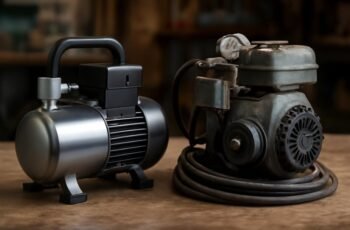
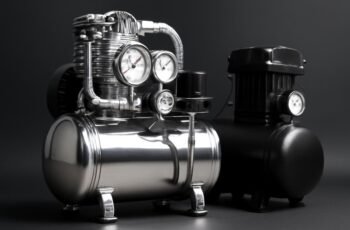
Imagine fitting a tall, slender tree into a compact garden plot, versus planting a broad, sturdy hedge that demands more space—this captures the essence of vertical versus horizontal air compressors. The choice impacts not just space but also efficiency, stability, and application suitability. Understanding these differences is indispensable for optimizing performance and operational costs, yet the decision isn’t always straightforward. Let’s explore how these designs align with specific needs and environments to guide your selection.
Key Takeaways
- Vertical compressors save space and are ideal for confined areas, while horizontal compressors offer stability and higher capacity for industrial needs.
- Vertical units are portable and easier to move, suitable for temporary or mobile setups; horizontal units are more durable for continuous use.
- Horizontal compressors typically provide better heat dissipation, leading to higher energy efficiency and larger component capacity.
- Vertical compressors produce less noise, making them suitable for quiet environments with space restrictions.
- Selection depends on space, capacity requirements, noise considerations, and whether portability or stability is prioritized.
Understanding the Key Differences Between Vertical and Horizontal Air Compressors
When comparing vertical and horizontal air compressors, understanding their fundamental structural differences is essential for selecting the right equipment for specific applications. Vertical compressors often offer enhanced vertical efficiency by optimizing space utilization and reducing footprint, making them suitable for confined environments. In contrast, horizontal compressors typically demonstrate superior horizontal durability due to their stable base and reinforced construction, allowing for long-term operation under demanding conditions. The vertical design minimizes the footprint but may require more precise maintenance access, while horizontal models are generally easier to service due to their layout. Analyzing these structural aspects helps determine which orientation provides the best balance of efficiency and durability for particular industrial needs. Recognizing these differences ensures informed decisions aligned with operational priorities.
Advantages of Vertical Air Compressors for Limited Space and Portability
Vertical air compressors are particularly advantageous in environments where space constraints limit equipment footprint. Their compact storage design allows them to fit into tight spaces, optimizing available room without sacrificing capacity. The vertical orientation reduces the overall footprint, making it easier to integrate into confined work areas or cluttered workshops. Additionally, their design enhances easy mobility, often featuring built-in handles or casters that facilitate transportation between job sites or storage locations. This portability is essential for contractors or maintenance teams needing quick deployment and repositioning. By combining space-efficient storage with effortless movement, vertical air compressors enhance operational flexibility. They are ideal for applications requiring reliable compressed air in limited spaces while maintaining ease of handling and repositioning.
Benefits of Horizontal Air Compressors for Stability and Larger Capacity
Horizontal air compressors offer notable advantages in terms of stability and capacity, making them well-suited for heavy-duty applications. Their design provides a low center of gravity, enhancing stability during continuous operation and reducing vibrations. This stability allows for larger, more robust components, resulting in increased capacity to handle higher air demands. Additionally, the horizontal orientation typically features a compact design, optimizing space without sacrificing performance. This configuration also promotes energy efficiency by enabling more effective heat dissipation, reducing operational costs. The combination of stability, larger capacity, and energy-conscious operation makes horizontal compressors ideal for industrial environments where performance and durability are critical. Overall, their structural benefits support sustained, efficient output in demanding applications.
Which Air Compressor Type Is Best for Your Specific Application?
Selecting the right air compressor depends heavily on the specific demands of your application, as different designs excel under varying operational conditions. When choosing between vertical and horizontal models, consider these factors:
- Space constraints: Vertical compressors offer a compact design, ideal for limited spaces.
- Noise reduction: Vertical units typically produce less noise, beneficial for noise-sensitive environments.
- Portability: Vertical compressors are easier to move, suited for mobile or temporary setups.
- Capacity needs: Horizontal compressors often provide higher airflow rates, suitable for larger-scale applications.
Ultimately, matching your operational requirements with the compressor’s design attributes ensures optimal performance, efficiency, and ease of integration into your existing setup.
Factors to Consider When Choosing Between Vertical and Horizontal Models
When evaluating different air compressor models, it’s essential to weigh specific factors that influence performance, installation, and operational efficiency. One key consideration is the compact design, which affects space utilization and ease of transport. Vertical models typically offer a smaller footprint, making them ideal for limited spaces, while horizontal units may require more room but can provide easier access for maintenance. Additionally, weight distribution is crucial; vertical compressors often have a lower center of gravity, enhancing stability during operation and transport. Conversely, horizontal models distribute weight more evenly across a broader base, which can improve support and reduce vibration. Both orientations impact installation requirements and operational logistics, so analyzing these factors helps determine the best fit for specific workspace constraints and performance needs.
Common Use Cases and Recommendations for Each Air Compressor Orientation
Are vertical and horizontal air compressors best suited for specific operational scenarios? Yes, their orientation influences application suitability. Vertical compressors excel in tight spaces, offering a compact noise profile and easier maintenance access, making them ideal for small workshops or confined environments. Conversely, horizontal models are better for continuous, heavy-duty operations due to enhanced stability and larger capacity. Specifically:
- Use vertical compressors in limited space settings requiring low noise and straightforward maintenance.
- Opt for horizontal units when high capacity and durability are priorities.
- Choose vertical models for intermittent use where space efficiency is critical.
- Select horizontal compressors in industrial applications with extensive operational demands.
Understanding these use cases helps optimize performance, maintenance, and environmental considerations, aligning compressor orientation with operational needs.
Frequently Asked Questions
How Does Maintenance Differ Between Vertical and Horizontal Air Compressors?
We find maintenance differs mainly in checklist complexity versus durability, with vertical units often easier to access for repairs, while horizontal compressors require careful installation considerations for stability and portability, impacting long-term upkeep and operational efficiency.
Are Vertical or Horizontal Compressors More Energy-Efficient?
We find that vertical compressors often excel in vertical efficiency, but horizontal models can outperform in horizontal efficiency, depending on design. Ultimately, the most energy-efficient choice hinges on specific operational conditions and maintenance practices.
Can Vertical Compressors Handle Higher Pressure Requirements?
Vertical compressors generally handle higher pressure requirements better due to their pressure capabilities and orientation durability, making them suitable for demanding applications. Their vertical design offers enhanced stability and robustness, which supports consistent performance under elevated pressure conditions.
What Are the Noise Level Differences Between the Two Types?
We find vertical compressors tend to be quieter, offering a favorable noise comparison, while horizontal models may generate more noise. Maintenance considerations include noise reduction options, but overall, vertical units often provide a more silent operation for demanding environments.
Which Orientation Offers Better Airflow and Cooling Efficiency?
We find horizontal compressors typically provide superior airflow dynamics and cooling airflow due to their wider, more accessible cooling pathways, enhancing heat dissipation. Vertical units may restrict airflow, potentially reducing cooling efficiency, especially in compact or confined setups.
Conclusion
In our analysis, understanding that vertical compressors occupy approximately 30% less space than horizontal models helps optimize workspace design. For applications requiring mobility or limited space, vertical units excel, while horizontal compressors support continuous, high-capacity tasks with superior stability and heat dissipation. Selecting the right type hinges on balancing space constraints, operational demands, and long-term efficiency. Making an informed choice ensures optimal performance, reducing downtime by up to 25% in industrial settings.