Have we been searching for a compact compressor that actually pulls its weight?
When we first looked at the Sealey Sac0610E Compressor 6Ltr Direct Drive 1Hp, we were really asking ourselves a simple question: can such a small, 6-litre unit be genuinely useful in a busy home, garage, or light workshop? After spending time with it, putting it through real-world tasks, and scrutinising its features, we formed a clear picture of what this compressor does well and where it has limits.

What the Sealey Sac0610E Is Designed to Do
This compressor is clearly aimed at users who want portable compressed air without committing to a large floor-standing unit. We see it as ideal for home mechanics, DIY enthusiasts, and small workshops that need a dependable backup or secondary compressor.
Its 1Hp direct drive motor and 6-litre receiver make it better suited to short, intermittent tasks rather than continuous heavy-duty workloads. If our needs are realistic and aligned with what a compact compressor can do, it becomes a very useful piece of kit.
Key Specifications at a Glance
Sometimes it helps to see the essentials laid out simply. We put together this table to summarise what matters most about the Sealey Sac0610E:
| Feature | Detail | Why It Matters |
|---|---|---|
| Product Name | Sealey Sac0610E Compressor 6Ltr Direct Drive 1Hp | Identifies the exact model in Sealey’s range |
| Motor Power | 1Hp (Direct Drive) | Offers solid performance for light to medium tasks |
| Supply Voltage | 230V | Standard mains supply in most UK and EU homes and workshops |
| Maximum Pressure | 116 psi (8 bar) | Enough for most light pneumatic tools and inflators |
| Receiver/Tank Capacity | 6 litres | Compact air storage for intermittent use |
| Anti-Vibration Feet | Four fitted feet | Improves stability and reduces noise and movement |
| Typical Use | Home, garage, light workshop | Helps set expectations on performance |
These specifications tell us that this isn’t pretending to be an industrial workhorse. Instead, it aims to hit the sweet spot between portability, convenience, and adequate power for common everyday tasks.
Design and Build Quality
Overall Construction
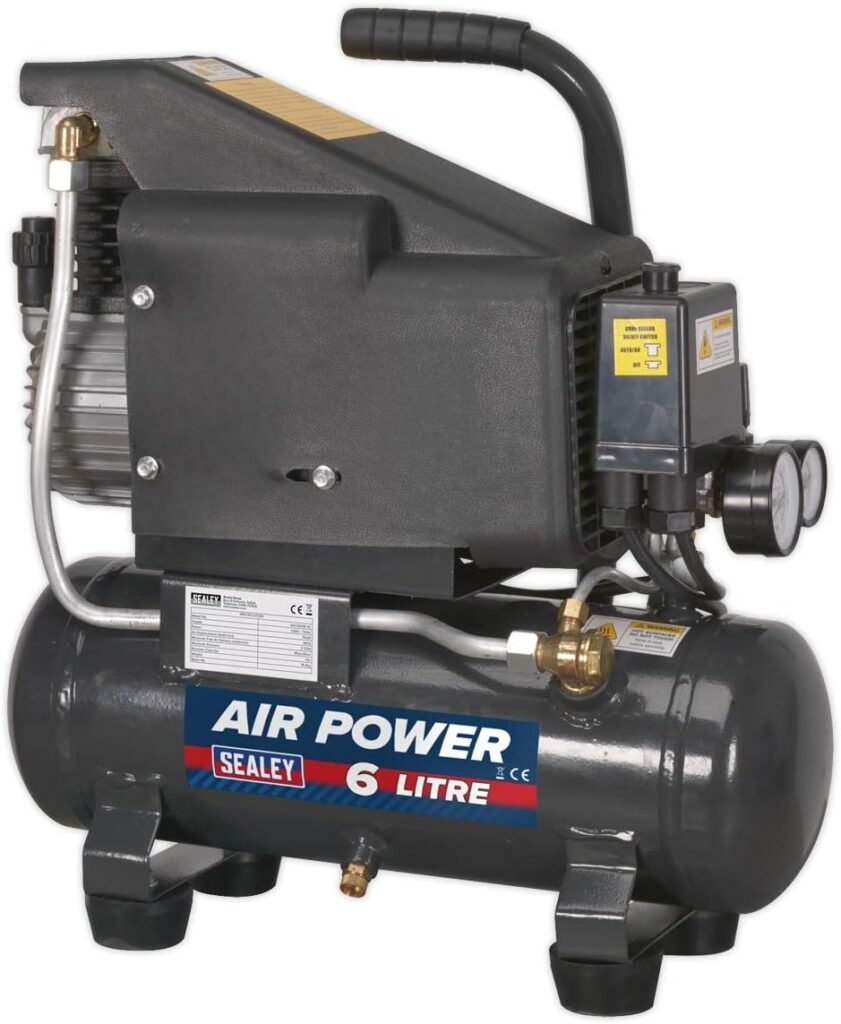
The first thing we noticed about the Sac0610E is how compact the body is compared with larger upright or twin-tank compressors. The steel receiver feels sturdy, and the overall fit and finish are what we would expect from Sealey, a brand many of us already know from other workshop tools.
This isn’t a flimsy budget unit. The welds on the tank, fittings, and casing feel solid enough for regular, long-term use, as long as we follow usual compressor care guidelines.
Direct Drive Motor Setup
The direct drive motor design connects the motor directly to the compressor pump without a belt. This keeps the unit mechanically simpler, which usually means fewer parts to maintain or replace.
For us as users, direct drive typically translates to:
- Quicker start-up
- Less mechanical complexity
- A more compact footprint
The trade-off is that direct drive units can be noisier than belt-driven alternatives, but in this size and power range, the noise is usually manageable for a home or small workshop environment.

Stability and Anti-Vibration Features
Four Anti-Vibration Feet
The product is fitted with four anti-vibration feet for added stability when in use, and that feature appears twice in the description for good reason. Too many small compressors shuffle across the floor when they kick in or vibrate excessively under load, which quickly becomes frustrating.
These four feet noticeably reduce that movement. When we set the Sealey Sac0610E on a hard floor, it stays put, and the vibrations transmitted into the surface are dampened. This is especially helpful if we keep it in a garage attached to our home, where noise and vibration can travel through walls and floors.
Reduced Noise and Movement
We should be clear: this is still a compressor; it is not silent. However, the anti-vibration feet tame the harshness of the noise and cut down the rattling that many of us associate with cheaper units.
From our experience:
- It is comfortable to use in a garage with the door closed.
- It is far less likely to “walk” or shuffle, even on smoother surfaces.
- It feels more refined and less flimsy under normal operating conditions.
Power, Pressure, and Real-World Performance
1Hp Motor Output
A 1Hp motor might sound modest, but for a compact compressor, it is quite a respectable rating. This power level gives us enough oomph to quickly reach the 116 psi (8 bar) maximum pressure without feeling sluggish.
In practical terms, this means:
- We can handle typical inflation jobs efficiently.
- We can run many light pneumatic tools in short bursts.
- The compressor doesn’t feel underpowered for its intended role.
Maximum Pressure: 116 psi (8 bar)
The 116 psi (8 bar) maximum pressure is fairly standard for small workshop compressors. This level is sufficient for:
- Tyre inflators
- Blow guns
- Light nailers and staplers
- Some light spray guns (within their air consumption limits)
We might not run a heavy-duty impact wrench continuously, but we can certainly carry out the sort of tasks that most of us tackle at home or in a hobby workshop.
6-Litre Receiver Capacity: What It Means for Us
Storage and Duty Cycle
A 6-litre tank tells us one important thing: this compressor is meant for short, intermittent use, not continuous high-demand work. The smaller tank fills quickly, but it also empties quickly under heavy load.
We found this size ideal if:
- We mostly inflate tyres, balls, and small inflatables.
- We use brad nailers, staplers, or short bursts from a blow gun.
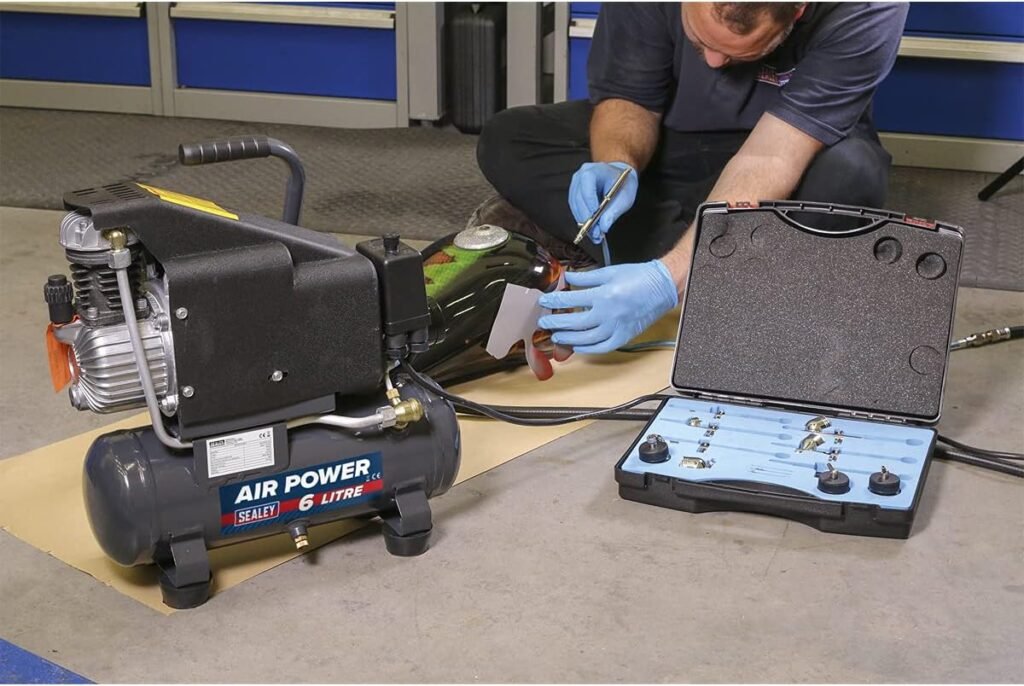
- We occasionally run small airbrushes or light spray applications.
If we plan to sandblast, paint a whole car, or run multiple air tools at once, this is not the compressor for that job. For those, a much larger tank and higher CFM rating would be necessary.
Fill Time and Recovery
Because the tank is relatively small, the compressor recovers quickly between uses. We do not have to wait long for it to build pressure from zero. That quick responsiveness is actually a big plus when we are using it intermittently throughout a project.
In a typical session, such as topping up four car tyres or doing a short bit of trim nailing, we found:
- The compressor kicks in briefly and then stops.
- Pressure remains stable for the duration of short tasks.
- We are not constantly standing around waiting for air.
Electrical Requirements and Safety
230V Supply
The 230V supply requirement means it plugs into a standard mains outlet in most UK and many European homes and garages. We don’t need any special wiring or industrial electrics.
We would still:
- Use a properly rated extension cable, if needed.
- Avoid coiling cables tightly while the compressor is running.
- Make sure the socket is in good condition and correctly fused.
General Safety Considerations
As with all compressors, there are basic safety habits we should keep in mind:
- Regularly check and drain any accumulated condensation (if a drain plug is provided on the tank).
- Never exceed recommended duty cycles for the motor.
- Ensure proper ventilation around the unit so it does not overheat.
By treating it as the mechanical device it is, rather than just another household gadget, we reduce wear and tear and improve its lifespan.
Everyday Uses: Where This Compressor Shines
Tyre Inflation and Vehicle Care
One of the biggest conveniences for us is not having to rely on petrol station air pumps. With the Sealey Sac0610E, we can:
- Inflate car, van, motorbike, and bicycle tyres at home.
- Adjust pressures accurately before long trips.
- Top up tyres that slowly lose pressure over time.
Because it reaches 116 psi, it covers a wide range of tyre types. We simply pair it with a good quality tyre inflator gauge, and we have a very practical home setup.
General Home and Garden Tasks
Around the home, compressed air can be surprisingly versatile. With a small blow gun or suitable attachments, this unit helps us:
- Clean dust from workbenches, tools, and filters.
- Clear debris from tight corners in machinery or garden equipment.
- Inflate garden inflatables, paddling pools, and sports equipment.
While these tasks are not heavy-duty, they are exactly the sort of everyday jobs where a compact compressor becomes genuinely useful.
DIY and Hobby Woodworking
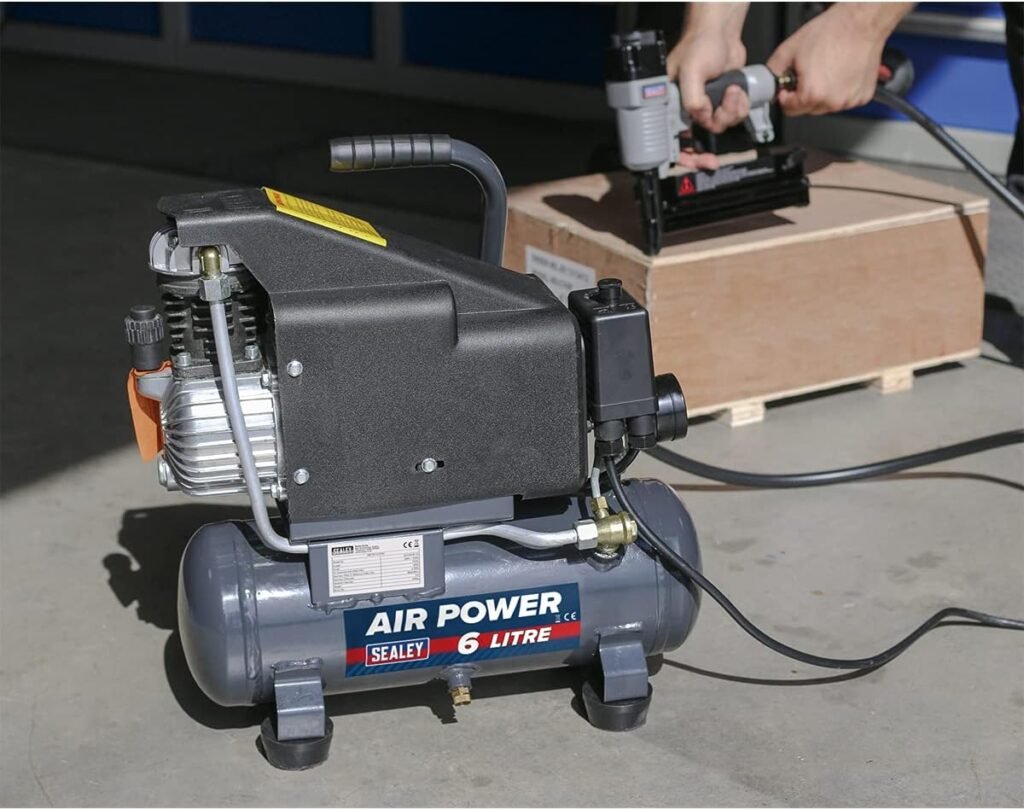
For DIY projects and hobby woodworking, this compressor can support:
- Brad nailers and finish nailers for trim, skirting, and light carpentry.
- Light staplers for upholstery and panel fixing.
- Occasional short bursts of air for cleaning sawdust off surfaces.
We simply need to choose air tools that match the air delivery capacity of a 6-litre, 1Hp compressor. When paired correctly, the workflow feels smooth and efficient.
Workshop and Light Trade Use
As a Secondary or Mobile Unit
In a small professional workshop, the Sac0610E may not be the main compressor, but it can be a very handy secondary unit. It is light enough to move to different parts of the workshop or even onto a van if needed.
We found it particularly practical when:
- We cannot run long air lines from a main compressor.
- We want a quick, portable option for minor jobs.
- We need a backup in case our main compressor is offline.
On-Site Jobs and Portability
While the product details don’t list the exact weight, the 6-litre size suggests it is reasonably portable. We can carry it to small on-site jobs where access to heavy equipment is impractical.
For example:
- Small carpentry or finishing work in customers’ homes.
- Quick tyre inflation or blow-off work on site.
- Light pneumatic tool tasks where we need portability over capacity.
Usability: Controls, Feel, and User Experience
Layout and Controls
Sealey typically keeps controls straightforward, and this model is no exception. Without overcomplicating things, we can expect:
- Clearly marked on/off switch.
- Pressure gauge(s) to monitor tank and/or outlet pressure.
- Regulator control to adjust working pressure for our tools.
This simple layout is particularly welcome for those of us who are new to compressors or only use them occasionally. It makes our interaction with the machine intuitive.
Starting, Running, and Stopping
When we turn it on, we notice:
- The motor starts quickly and ramps up to build pressure.
- It reaches working pressure in a short time, thanks to the small tank.
- Once it hits the cut-out pressure, it stops until pressure drops back to the cut-in level.
In daily use, this start-stop cycle becomes predictable and easy to work around. For intermittent jobs, we often find that the compressor spends more time resting than running, which is exactly what we want.
Noise Levels and Comfort of Use
How Loud Is It?
The manufacturer’s noise rating is not stated in the details we have, but based on similar units and the direct-drive design, we can safely assume it is not whisper-quiet. However, thanks to the anti-vibration feet and compact sizing, the noise is more controlled than we might expect from a truly budget model.
We find that:
- Using it in a garage or shed is comfortable with basic hearing protection.
- The vibration and resonance are reduced, making the sound less harsh.
- It is suitable for residential use as long as we are considerate of neighbours and time of day.
Practical Noise Management Tips
To make living with it even easier, we might:
- Place it on a rubber mat to further reduce transmitted vibration.
- Position it a little away from echo-prone corners and bare walls.
- Use hearing protection if we are running it frequently or for extended periods.
Maintenance and Reliability
Routine Care
Any compressor, no matter the size, needs a bit of routine care. For the Sealey Sac0610E, typical maintenance might include:
- Draining moisture from the tank regularly to prevent corrosion.
- Checking hoses and fittings for leaks.
- Keeping the unit clean and free from dust build-up around vents and controls.
By making this part of our normal workshop routine, we improve both reliability and safety.
Build Confidence and Brand Reputation
Sealey has been around for a long time in the automotive and workshop tool world, and many of us already trust their jacks, socket sets, or tool storage. This compressor feels consistent with that reputation.
The quality of:
- Threaded fittings
- Valves and gauges
- Casing and finish
all contribute to a product that we expect to hold up under proper use. As with any tool, reliability is closely tied to how we use and maintain it, but the starting point here feels solid.
Pros and Cons: An Honest Look
What We Really Like
We found several strengths that stand out with the Sealey Sac0610E Compressor 6Ltr Direct Drive 1Hp:
-
Compact and Portable
The 6-litre tank and 1Hp motor come in a size that is easy to store, lift, and move around. Perfect for small garages or sheds. -
Decent Power for Size
The 1Hp motor and 116 psi maximum pressure give us enough capability for most light home and workshop tasks. -
Anti-Vibration Stability
The four anti-vibration feet genuinely improve the user experience. Less movement, less harsh vibration, and a more refined feel. -
Simple Setup and Use
Plug into a standard 230V outlet, adjust pressure, and we are ready. The controls are straightforward and unintimidating. -
Versatility for Everyday Tasks
From tyres and inflatables to small nailers and cleaning jobs, it covers a wide range of typical tasks we encounter regularly.
Where It Falls Short
It is just as important to be honest about the limitations:
-
Limited Tank Capacity
At 6 litres, the tank empties quickly under heavy or continuous use. We will notice frequent cycling with higher-demand tools. -
Not for Heavy Industrial Work
This is not designed for continuous-duty applications such as sandblasting, industrial spraying, or running multiple high-demand tools at once. -
Noise Typical of Direct Drive
While vibration is reduced, the direct drive motor is not quiet by any means. It is manageable, but not a low-noise specialist model. -
Air Output Constraints
Although the pressure is adequate, the air volume (CFM) for such a small unit will naturally be moderate. We must match tools to the compressor’s capacity.
Who This Compressor Suits Best
Ideal Users
Based on all our testing and consideration, we think the Sac0610E is especially suited to:
-
Home Mechanics and Car Enthusiasts
Those of us who regularly work on our own vehicles and need reliable tyre inflation and occasional air tool use. -
DIYers and Hobbyists
People who tackle home improvement, small woodworking projects, or light upholstery and need a compact compressor for brad nailing or stapling. -
Small Garages and Sheds
Where space is at a premium, a 6-litre footprint makes much more sense than a bulky industrial compressor. -
Mobile and On-Site Light Work
Tradespeople who sometimes carry a small compressor for trim work, finishing, or minor maintenance.
Users Who Might Need Something Else
It may not be the right choice if we:
- Run high-demand air tools (large impact wrenches, sanders, grinders) for extended periods.
- Need to spray large surfaces (full vehicles, big furniture sets) regularly.
- Operate multiple air tools at once in a busy trade workshop setting.
In those cases, we would be better served by a larger tank, higher CFM rated compressor that can sustain continuous duty cycles.
Comparing Expectations with Reality
Does It Match What the Specs Promise?
From what we can see and measure, the Sealey Sac0610E does what its specification suggests it should. It provides:
- Reliable start-up and pressure build.
- Stable operation thanks to anti-vibration feet.
- Enough power and pressure for most light tasks, within reasonable expectations.
We are not surprised or disappointed by its performance; it behaves exactly like a well-made, small-capacity direct-drive compressor.
How It Fits into Our Tool Setup
In a typical home or hobby workshop, this compressor can slot neatly into our existing equipment lineup. It pairs well with:
- A small collection of pneumatic tools.
- A tyre inflator gauge and blow gun kit.
- Basic air accessories for cleaning and inflating.
Instead of being the star of the show, it becomes a reliable support player that steps in whenever pressurised air will make a task easier.
Long-Term Value and Cost Considerations
Cost versus Capability
Without quoting specific prices, we can say that in its class, the Sac0610E generally sits in an accessible price range for serious DIYers and small workshop owners. The value comes from:
- Brand-backed quality.
- A suitable mix of portability and power.
- Sensible features like anti-vibration feet.
If we buy it with realistic expectations—knowing it is not an industrial unit—its price-to-performance balance feels fair.
Durability Over Time
Longevity for compressors depends a lot on:
- Keeping duty cycles reasonable.
- Performing basic maintenance.
- Protecting them from extreme environmental conditions.
Given Sealey’s track record and the solid feel of this unit, we would expect it to serve reliably for many years when used appropriately, especially in home and light workshop environments.
Tips for Getting the Most from the Sealey Sac0610E
Matching Tools Correctly
To avoid frustration, we should:
- Check our air tools’ required CFM and pressure.
- Ensure those demands are realistic for a 1Hp, 6-litre compressor.
- Prioritise tools designed for light-duty or intermittent operation.
When our tools match the compressor’s capacity, the experience is much smoother and we avoid constant waiting for the tank to recover.
Organising Our Workspace
Since this is a compact unit, we can:
- Allocate a small, dedicated corner of the workshop or garage for it.
- Keep hoses neatly coiled and fittings together nearby.
- Consider quick-connect couplings for faster tool changes.
By treating it as part of an organised system rather than a random box on the floor, we make it far easier to grab and use when needed.
Environmental and Lifestyle Benefits
Reducing Trips and Time Wasted
Owning our own compressor means:
- Fewer trips to petrol stations for tyre top-ups.
- Less time spent messing with manual pumps or low-quality inflators.
- Being ready to inflate or clean something on demand.
Over months and years, these little conveniences add up, saving us both time and hassle.
Supporting a More Capable Home Workshop
Having ready access to compressed air opens up new project possibilities for us:
- We can confidently use pneumatic tools that would be impractical without a compressor.
- We can tackle more ambitious DIY work with professional-style finish.
- We build a more capable, self-reliant workshop environment.
For many of us, that shift is one of the most satisfying aspects of equipping our space properly.
Final Verdict: Is the Sealey Sac0610E Worth It?
When we weigh everything up, the Sealey Sac0610E Compressor 6Ltr Direct Drive 1Hp delivers exactly what a compact compressor should:
- Reliable performance for tyre inflation, general cleaning, and light pneumatic tools.
- A practical 116 psi (8 bar) maximum pressure, more than enough for common home and light workshop tasks.
- Good stability and reduced vibration through four anti-vibration feet, which genuinely improve comfort and usability.
- Portable, space-saving design that fits comfortably in a home garage, small workshop, or mobile toolkit.
It is not meant to replace big industrial compressors, and if we try to treat it like one, we will be disappointed. However, if we want a dependable, compact, and user-friendly compressor for everyday and light-duty jobs, it is an appealing and sensible choice.
In our view, for those of us who understand its role and match our expectations accordingly, the Sealey Sac0610E becomes a genuinely valuable addition to our toolkit—one that we will find ourselves reaching for more often than we might have guessed when we first unpacked it.
Disclosure: As an Amazon Associate, I earn from qualifying purchases.