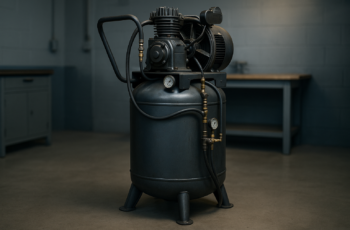
Looking for a powerful workshop air compressor that actually keeps up with you?
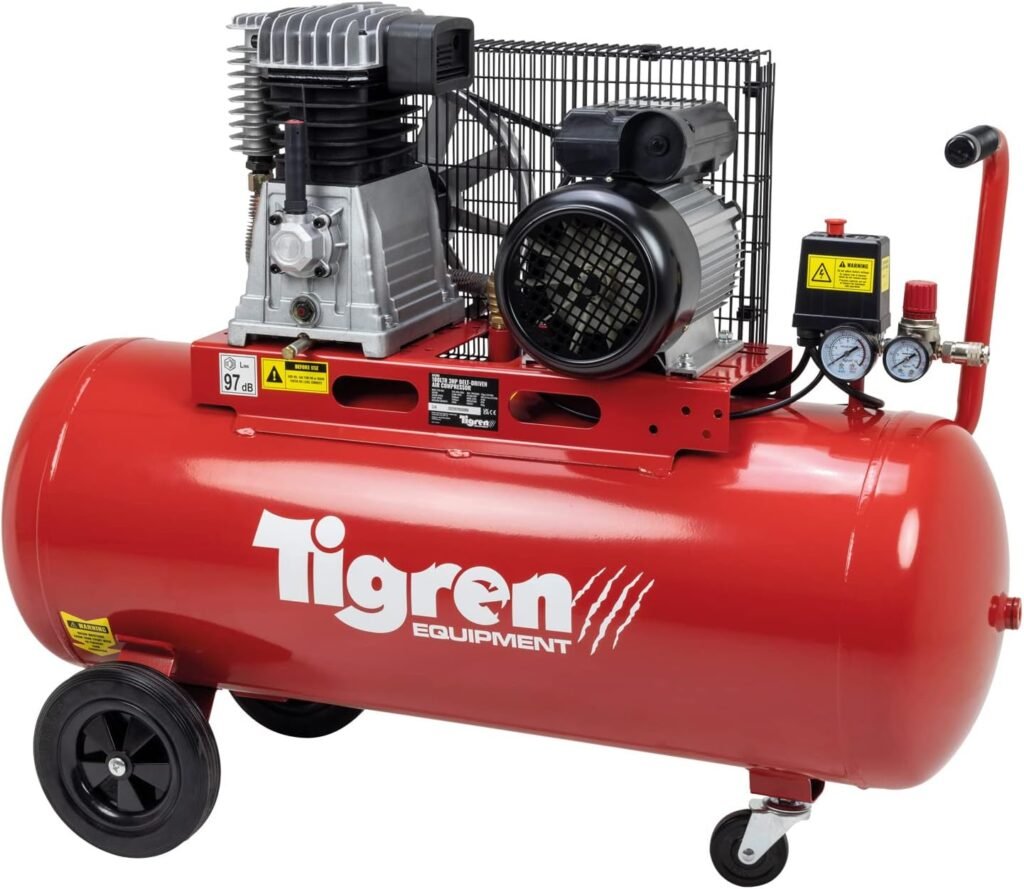
When we set up or upgrade our garage or workshop, air power is often right at the heart of what we do. From running impact wrenches and spray guns to blowing dust off benches and inflating tyres, a compressor can make or break our workflow. The TIGREN Belt Drive Air Compressor, Twin Cylinder Oil-Lubricated 230V 13A, 100L, 3hp / 2.2kW, 150psi / 10 Bar 14CFM 97dB is built to be more than a basic hobby unit. It aims to bridge the gap between DIY and serious trade use, and in this review we go through how well it actually manages that.

Key Specifications at a Glance
Before we get into real-world use, it helps us to see the main specs laid out clearly. That way we know what kind of jobs this compressor is actually built for.
| Feature | Detail |
|---|---|
| Brand / Model | TIGREN Belt Drive Air Compressor |
| Motor Power | 3 hp / 2.2 kW |
| Power Supply | 230V, 13A (standard UK domestic supply) |
| Drive Type | Belt drive |
| Cylinder Configuration | Twin cylinder |
| Tank Capacity | 100 litres |
| Maximum Pressure | 150 psi / 10 bar |
| Air Delivery (Approx.) | 14 CFM (cubic feet per minute) |
| Lubrication Type | Oil-lubricated |
| Noise Level | 97 dB (approximate) |
| Intended Use | Garage, workshop, trade, light industrial, professional applications |
This specification set positions the TIGREN as a serious piece of kit for regular and demanding use, not just the occasional bit of tyre inflating at the weekend.
Overall Design and Build Quality
We notice straight away that this is not a compact, ultra-portable “mini” compressor. The 100L tank and belt-driven twin cylinder setup give it a purposeful, professional presence. That’s usually a good sign for durability and sustained use.
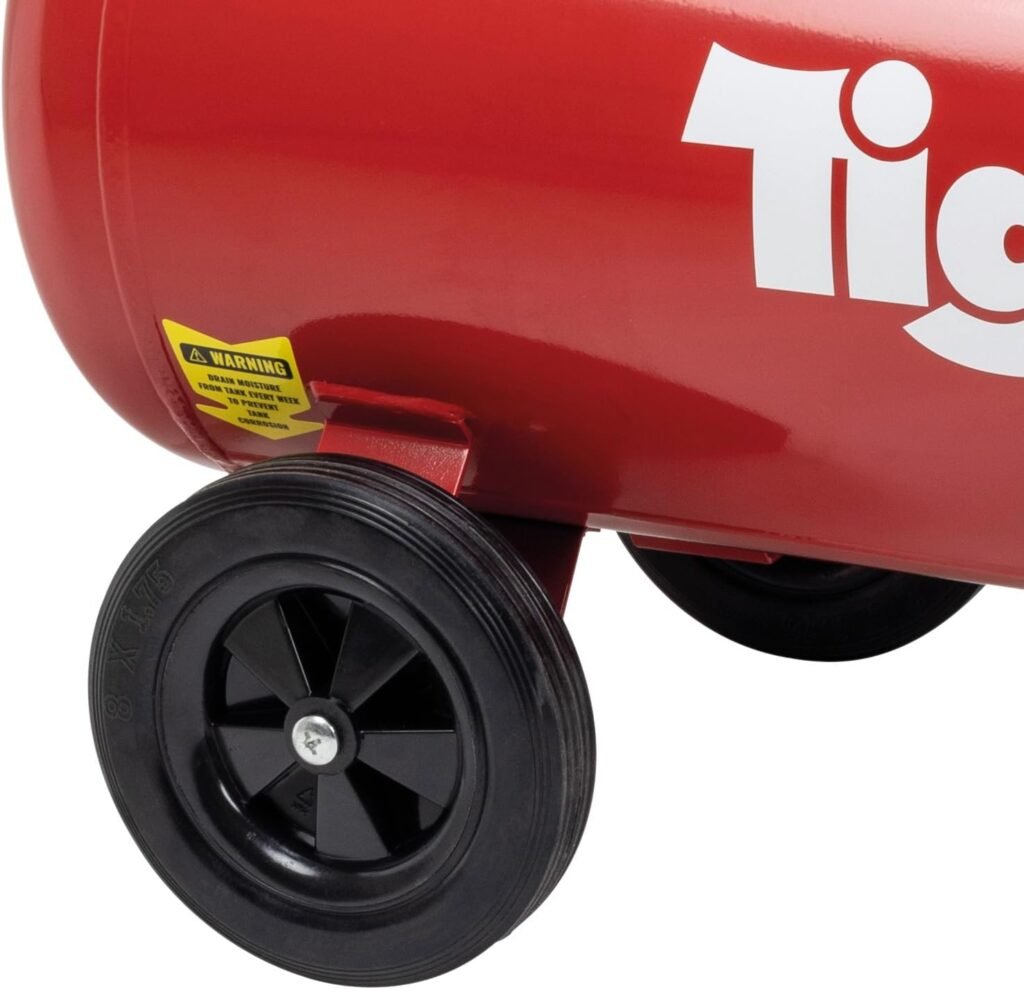
The chassis, tank, and main components feel robust and engineered for daily work, not just light DIY. The welded tank looks solid, the handle and wheels give it a stable footprint, and the overall construction suggests it’s designed to endure workshop environments with regular vibrations, tool changes, and occasional knocks.
In short, the TIGREN’s build makes us feel like we’re dealing with a genuine workshop machine rather than a consumer-grade toy.
Power and Performance
When we look at performance, we tend to think about two things: how quickly the compressor builds pressure, and how well it keeps up while we’re using air tools. The TIGREN’s 3 hp / 2.2 kW motor and 14 CFM delivery figure tell us a lot about what to expect.
Motor: 3 hp / 2.2 kW – What That Means for Us
A 3 hp motor on a 230V 13A supply is pretty much the upper end of what most domestic UK circuits will comfortably support without going for special wiring. That’s good news for us because it means we can run a seriously capable compressor from a normal socket (with proper attention to extension leads and wiring length).
In practice, a 3 hp motor gives enough grunt to:
- Refill the 100L tank in reasonable time
- Support high-demand tools intermittently
- Maintain pressure for most light-to-medium duty workshop tasks
We should still respect that continuous full-load running is tough on any compressor, but for most of our garage workflows this power level is a strong sweet spot.
Airflow and Pressure: 14 CFM at Up to 150 psi / 10 bar
The 14 CFM figure is important because it tells us how much air we can expect the compressor to provide when in use. Many air tools list two air requirements:
- Working pressure (often around 90 psi / 6.2 bar), and
- Air consumption (usually in CFM or L/min).
With 14 CFM available and up to 150 psi / 10 bar maximum pressure, we’re looking at a compressor that comfortably supports:
- Impact wrenches (especially 1/2″ drive used in automotive work)
- Ratchets and air chisels for intermittent use
- HVLP and conventional spray guns with suitable nozzles
- Tyre inflators and blow guns
- Air sanders and grinders for shorter bursts or intermittent operation
We still want to check each tool’s CFM requirement, but 14 CFM at 10 bar gives us a generous envelope for a wide range of workshop tasks.
Belt Drive and Twin Cylinder Configuration
One of the standout characteristics of this TIGREN compressor is its belt-driven, twin-cylinder setup. This is a clear step above the small direct-drive units many of us start with.
Why Belt Drive Matters
A belt drive means the motor and pump are connected via a belt and pulleys rather than being directly coupled. That has several benefits:
- Reduced vibration: Belt drive tends to run smoother than direct drive.
- Lower pump speed: The pump does not have to spin at motor speed, which usually extends its life.
- Potentially better cooling: Lower RPM and freer-running pumps often run cooler.
- Serviceability: Belts can be replaced, and pulleys adjusted if needed.
In day-to-day use, this generally translates into a more durable, workshop-friendly unit. It can also influence noise characteristics, though the TIGREN is still a fairly loud machine (97 dB), which we’ll get to later.
The Advantage of Twin Cylinders
Twin cylinders usually mean more air is compressed per revolution compared to a single cylinder. For us, that usually yields:
- Faster tank fill times
- Smoother delivery of air
- Better efficiency under sustained workloads
We like twin cylinder designs for anyone who plans to use air tools regularly or needs strong performance for paint spraying or industrial-style tasks.

Oil-Lubricated Pump: Efficiency and Longevity
The TIGREN’s oil-lubricated design is another feature that shifts it into the professional category. Rather than trying to run dry (oil-free), the pump uses lubrication to reduce friction and manage heat.
How Oil-Lubrication Helps Us
Oil-lubricated compressors tend to:
- Run cooler, which is vital for long-term reliability.
- Last longer, because the moving parts experience less wear.
- Operate more efficiently, thanks to reduced internal friction.
In the TIGREN’s case, oil is injected into the compression process and then separated from the compressed air. That allows the machine to deliver clean air while still benefitting from internal lubrication.
Maintenance Considerations
We do have to be prepared to maintain oil-lubricated equipment properly. That means:
- Checking oil levels regularly
- Changing oil at recommended intervals
- Keeping an eye out for any leaks or contamination
This isn’t difficult, but it’s something we need to be disciplined about. In return, we usually get a machine that outlasts cheaper, oil-free alternatives and handles heavier workloads gracefully.
Tank Capacity: 100 Litres for Consistent Air Supply
A 100L tank is a substantial step up from the 24L or 50L units that many of us start with. That extra capacity really shows up in how steadily our tools can run.
Why 100L Makes a Difference
With 100 litres of compressed air stored, we benefit from:
- Longer continuous tool operation before pressure drops
- Fewer motor restarts, which can extend the motor’s lifespan
- Smoother pressure stability, especially in spray applications
For spraying paint, running air drills, or using blow guns for extended cleaning sessions, the difference between a 50L and 100L tank is very noticeable. We can usually get more done between compressor cycles, and the pressure fluctuations are reduced.
Practical Workshop Fit
Of course, a 100L unit takes up more floor space than a compact model. However, the TIGREN seems designed with a standard workshop in mind. We can usually tuck it against a wall or in a corner, run a hose line out to where we work, and forget it’s there until the motor kicks in for a refill.
Noise Level: 97 dB and What That Means for Us
At around 97 dB, this compressor is not quiet. That’s fairly typical for a powerful belt-driven unit but it’s still something we need to think about when setting it up.
Working Comfort and Safety
At 97 dB:
- We really should wear hearing protection when working nearby.
- Placing the compressor in a side room or at the far end of the garage can improve comfort.
- Using longer air lines to keep noisy machinery away from us is a good strategy.
For comparison, 97 dB is significantly louder than normal conversation and sits closer to the noise level of a motorcycle or a loud lawnmower. It’s manageable, but we don’t want to stand next to it for long periods without protection.
Mitigating the Noise
We can also consider practical steps like:
- Mounting the compressor on rubber feet or pads to reduce vibration transmission
- Ensuring it’s on a level surface to avoid rattling
- Keeping loose items away from it so they don’t buzz when it’s running
Noise is part of the reality of powerful compressors, and the TIGREN is no exception. The performance is there, but we should plan our workspace accordingly.
Usability and Ease of Operation
While the TIGREN is clearly a serious bit of equipment, it’s also described as being designed with operational ease in mind. That’s important for us because we don’t want a machine that’s a hassle every time we switch it on.
Controls and Basic Operation
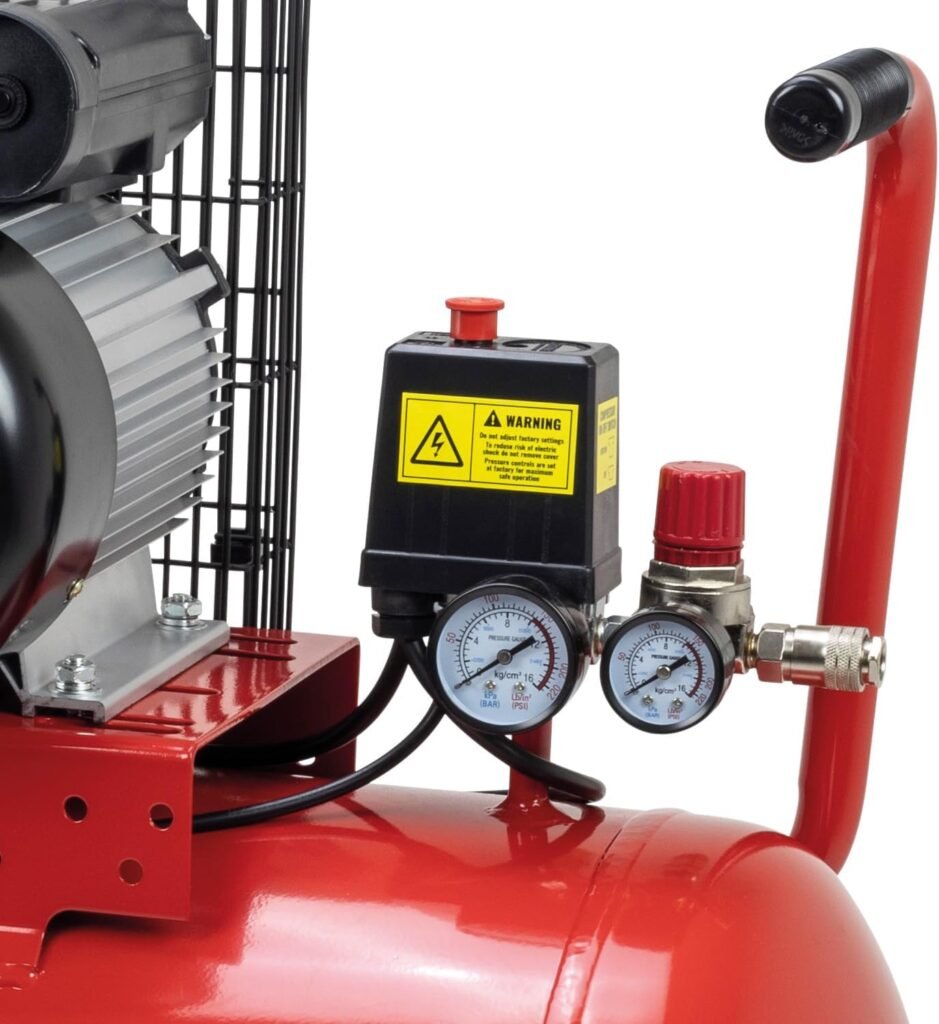
Most belt-driven workshop compressors follow a similar layout, and the TIGREN fits right into that familiar pattern:
- On/off switch or isolation switch
- Dual pressure gauges (one for tank, one for regulated outlet)
- Pressure regulator knob
- Quick-connect coupler(s) for air hoses
This makes it easy for us to:
- Power on and let the tank reach the cut-out pressure.
- Adjust the regulator to the pressure we want for a particular tool or spray gun.
- Disconnect and swap tools quickly as tasks change.
We don’t need to be an expert to run this compressor, but we do benefit from having a basic understanding of safe operating pressures.
Mobility and Handling
With a 100L tank and a solid build, we’re not dealing with a featherweight machine. However, the TIGREN typically incorporates:
- Sturdy wheels at the rear
- A robust handle for tilting and rolling
- A stable front support or foot
This lets us move it around the workshop or garage without too much trouble, though we wouldn’t want to carry it up flights of stairs. Once in position, the footprint feels stable enough for daily use.
Ideal Applications: Where This Compressor Shines
The product description calls out a wide range of applications: garage use, workshop tasks, trade and professional work, paint spraying, airbrush work, and more. Let’s break down where this TIGREN really makes sense.
Automotive and Garage Work
For vehicle enthusiasts and mechanics, the TIGREN’s combination of 3 hp power, 14 CFM airflow, and 100L capacity is extremely appealing. We can comfortably use:
- Impact wrenches for wheel nuts and suspension work
- Ratchets for tighter spaces
- Tyre inflators for cars, vans, motorcycles, and trailers
- Blow guns for cleaning brake dust and engine bays
- Air hammers or chisels for stubborn components (intermittently)
The key benefit is that we’re not constantly waiting for the tank to refill. For anyone who spends a lot of time in the garage, this can significantly speed up tasks.
Workshop and Trade Tasks
For carpenters, metalworkers, and general tradespeople, compressed air is incredibly versatile. This TIGREN unit supports:
- Nail guns and staplers
- Air sanders (in moderation – we should watch CFM requirements)
- Angle grinders and drills for short bursts
- Cleaning and drying components with a blow gun
In a small trade workshop, the TIGREN can serve as the main air source, as long as we respect its duty cycle and don’t ask it to power multiple high-CFM tools continuously.
Paint Spraying and Finishing
One of the highlights of this compressor is its suitability for spraying applications. The combination of 100L capacity, 14 CFM, and oil-lubricated efficiency contributes to:
- Steady pressure delivery for consistent spray patterns
- Reduced pressure drop during longer paint passes
- Sufficient volume for automotive panels, furniture, and hobby projects
We still want to fit appropriate air filtration and water traps, especially for fine finishing work. However, as a backbone for a spray setup, this compressor is well positioned.
Airbrush and Light Detail Work
While “airbrush compressor” might make us think of a tiny unit, the TIGREN offers:
- More than enough power for one or more airbrushes
- Steady airflow for detailed artwork, modelling, or custom paint
- The flexibility to handle heavier tasks as well
For pure airbrush-only use, a smaller, quieter unit might be more convenient. But if we want one compressor for both airbrush detail work and heavier garage tasks, this machine gives us that flexibility.
Not Just Another Mini Compressor
One of the phrases that stands out in the product description is that this is not just another mini air compressor. We think that’s accurate in several important ways.
Heavy-Duty Intent
Compared to compact, oil-free units that are marketed mainly for inflating tyres or blowing dust off tools, the TIGREN is:
- Built with a stronger motor and bigger tank
- Engineered with a belt-driven twin-cylinder pump
- Designed to handle genuine industrial and trade demands
This means we can trust it for proper workshop tasks rather than just occasional household jobs.
Professional Features in a Domestic-Friendly Package
While the machine is clearly suited to professional environments, the fact that it runs on a standard 230V 13A supply means:
- We don’t need industrial three-phase power
- We can still use it in a home garage with sensible electrical planning
- It bridges the gap between home enthusiast and small business use
In other words, it’s a serious compressor that many of us can realistically install and run without major infrastructure upgrades.
Performance in Real-World Scenarios
Technical specifications are useful, but what really matters is how a compressor behaves when we’re halfway through a job with dust on our hands and a deadline looming.
Short, High-Demand Tasks
For impact wrenching, tightening and loosening bolts, or running a nail gun, the TIGREN’s tank size and CFM rating keep pace comfortably. The motor cycles on and off in a healthy pattern, and we rarely feel like we’re outrunning the machine.
For things like intermittent spraying or tool use, the compressor tends to feel like it always has a reserve in the tank.
Longer Operations
For sustained sanding or grinding, we do need to be more aware of:
- The tool’s air consumption rate
- The compressor’s duty cycle (how long it should run vs. how long it should rest)
If we push any compressor beyond its ideal duty cycle, we shorten its lifespan and can cause overheating. The TIGREN handles prolonged use better than small units thanks to its oil-lubricated, belt-driven design and larger tank, but we still want to operate within sensible limits.
Consistency for Spraying
Paint spraying demands steady pressure to keep our finish uniform. With the TIGREN:
- The 100L tank smooths out fluctuations
- The twin-cylinder pump refills reasonably fast
- The 10 bar maximum gives headroom for regulation
As long as we match our spray gun and nozzle sizes to the compressor’s output and keep good water/oil filtration in line, we can expect a stable and repeatable spray pattern.
Maintenance and Care
To get the most out of an oil-lubricated compressor like this, we need to be consistent with basic maintenance. Thankfully, none of the tasks are particularly difficult.
Routine Tasks We Should Expect
We should plan for:
- Oil checks and changes: Keeping the oil level correct and replacing it at intervals.
- Drainage of the tank: Moisture inevitably accumulates inside; we don’t want rust eating away at our 100L tank.
- Filter checks: Ensuring air intake filters are clean and clear.
- Belt inspection: Checking tension and condition of the drive belt from time to time.
If we treat these as part of our normal workshop routine, the TIGREN should give us a long service life with minimal issues.
Long-Term Reliability
Because of the belt drive, oil lubrication, and twin-cylinder design, we’re looking at a compressor system structured for longevity. Small direct-drive, oil-free units can be more “disposable” in nature, whereas a belt-driven oil-lubricated unit invites us to maintain and keep it in service for many years.
Safety Considerations
With any compressor, and especially one with this level of power and capacity, we want to keep safety in mind at all times.
Basic Safety Points
We should always:
- Use hearing protection when standing near it while running (97 dB is loud).
- Place it on a level, stable surface to avoid tipping or moving under vibration.
- Ensure proper ventilation around the machine to dissipate heat.
- Avoid exceeding recommended pressure settings for tools and accessories.
- Regularly inspect hoses and couplings for wear, cracking, or leaks.
By respecting these basics, we keep ourselves and our equipment safe while benefiting from the compressor’s full capability.
Electrical Considerations
The TIGREN draws up to 13A on 230V, which is at the upper end for normal sockets. We should:
- Avoid using long, undersized extension leads that can overheat.
- Prefer a direct connection to a dedicated circuit where possible.
- Ensure sockets and wiring are in good condition and properly rated.
If we’re uncertain, consulting a qualified electrician is a sensible precaution, especially in a busy workshop where multiple machines may run simultaneously.
Pros and Cons Summary
To help us quickly see whether this compressor matches our needs, it’s useful to summarise its strengths and potential drawbacks.
Advantages
- Strong 3 hp / 2.2 kW motor: Plenty of power for demanding workshop tasks.
- Generous 100L tank: Good air reserve for consistent tool operation and spraying.
- Belt-driven twin-cylinder pump: Durable, efficient, and better suited for regular use.
- Oil-lubricated mechanism: Lower wear, better heat management, longer life.
- Up to 150 psi / 10 bar and around 14 CFM: Suitable for a wide variety of air tools and applications.
- Garage, workshop, and trade-ready: Built for more than just occasional DIY use.
- Standard 230V 13A operation: Compatible with typical domestic and small business setups.
Potential Drawbacks
- Noise level (97 dB): We need hearing protection and may want to position it away from main working areas.
- Size and weight: Not easily portable beyond ground-level workshop use.
- Requires regular maintenance: Oil checks and tank draining are necessary, not optional.
- May be overkill for very light, occasional home use: Some users might not need this much power or tank size.
For many serious DIYers, garage enthusiasts, and trade users, the advantages significantly outweigh the downsides, especially when we value reliability and performance.
Who This Compressor Is Best Suited For
Deciding whether the TIGREN is the right model for us depends on the kind of work we’re doing and how often we rely on compressed air.
Ideal Users
We think this compressor is particularly well suited to:
- Home mechanics and car enthusiasts who regularly work on vehicles and want serious impact wrench performance, tyre inflation capacity, and the ability to run blow guns and other tools with minimal waiting.
- Small workshops and tradespeople needing a dependable air source for intermittent but demanding tasks such as nailing, sanding, drilling, and occasional grinding.
- Painters and finishers who want a strong base unit for spraying automotive, furniture, or general projects where consistent pressure and reliable output are essential.
- Hobbyists with big ambitions, such as those working on restoration projects, metal fabrication, or custom builds who want a machine that grows with their needs.
Who Might Prefer Another Option
On the other hand, we might consider a different compressor if:
- We only inflate tyres a few times a year and occasionally use a blow gun.
- Space in our garage is extremely limited and we cannot accommodate a 100L machine.
- We need ultra-quiet operation above all else (for example, late-night work in a shared building).
In these situations, a smaller, quieter, or oil-free unit might be more appropriate, even if it sacrifices the heavy-duty capability of the TIGREN.
How This Model Fits into a Long-Term Workshop Plan
For many of us, setting up a workshop is a long-term project. We add tools and machinery over time, and the compressor often becomes one of the central investments that everything else plugs into.
A Core Piece of Infrastructure
The TIGREN can easily become the central air supply for:
- Impact, ratchet, and spray tools
- Air-powered clamps or fixtures
- Cleaning stations with blow guns
- Inflation stations for tyres and air-based systems
If we see ourselves expanding our tool collection and taking on more ambitious projects, this compressor gives us a foundation we can build around.
Future-Proofing Our Setup
By choosing a robust belt-driven, oil-lubricated unit instead of a cheaper, lighter-duty model, we reduce the chance of outgrowing our compressor too quickly. Instead of needing to replace a small unit in a year or two, we can let the TIGREN serve us through several phases of workshop growth.
Final Thoughts: Is the TIGREN Belt Drive Air Compressor Worth It?
When we look at everything together, the TIGREN Belt Drive Air Compressor, Twin Cylinder Oil-Lubricated 230V 13A, 100L, 3hp / 2.2kW, 150psi / 10 Bar 14CFM 97dB comes across as a serious, well-balanced choice for those of us who use compressed air as more than just an occasional convenience.
We get:
- A robust, trade-ready build
- A powerful motor with ample airflow
- A generous 100L tank for consistent operation
- The efficiency and longevity benefits of an oil-lubricated, belt-driven twin-cylinder pump
We do need to accept the realities of noise, size, and maintenance, but in return we gain a compressor capable of supporting demanding workshop, automotive, and spraying applications day after day.
If our goal is to equip our garage or workshop with a compressor that won’t hold us back as our projects grow in scale and complexity, the TIGREN stands out as a very compelling option. It feels built to be part of our long-term setup, giving us the confidence that when we reach for an air tool, the power we need is ready and waiting.
Disclosure: As an Amazon Associate, I earn from qualifying purchases.